
You feel great during your warm-up. The first few rounds of your workout are going smoothly. Then, somewhere between another set of deadlifts, a few minutes on the rower, and the next round of wall balls, you start to notice it: your low back feels tight, tired, or painful.
If your back feels fine at the beginning of a workout but starts bothering you as you get tired, it can be tempting to assume your form is breaking down or that something is wrong with your back.
But symptoms that show up with fatigue can tell us something different.
A more useful question than whether your back is strong enough is whether it has enough capacity for what you’re asking it to do.
What Changes When You Get Tired?
Fatigue is a normal part of training in CrossFit, running, lifting, or any other sport, and the way you move during the first few minutes of a workout probably won’t look exactly the same as it does near the end.
As fatigue builds, your muscles have to continue producing force repeatedly. Your breathing changes, different muscles may contribute more or less to a movement, and your body may adjust how it completes the task. Early fatigue of the spinal erector muscles is one reason movements like overhead pressing can bring on back tightness, as we describe in our overhead press article.
These changes don’t necessarily mean something is wrong. They’re part of how your body responds to increasing physical demands.
Your 30th deadlift doesn’t need to look identical to your first one. Some variability in movement is normal, especially as intensity and fatigue change.
Rather than chasing perfectly identical movement on every repetition, it can be more useful to ask:
Can you continue managing the demands of your workout without your symptoms progressively increasing or your ability to perform the movement significantly changing?
Strength and Capacity Aren’t the Same Thing
One of the biggest misconceptions about low back pain is that pain during exercise must mean your back is weak.
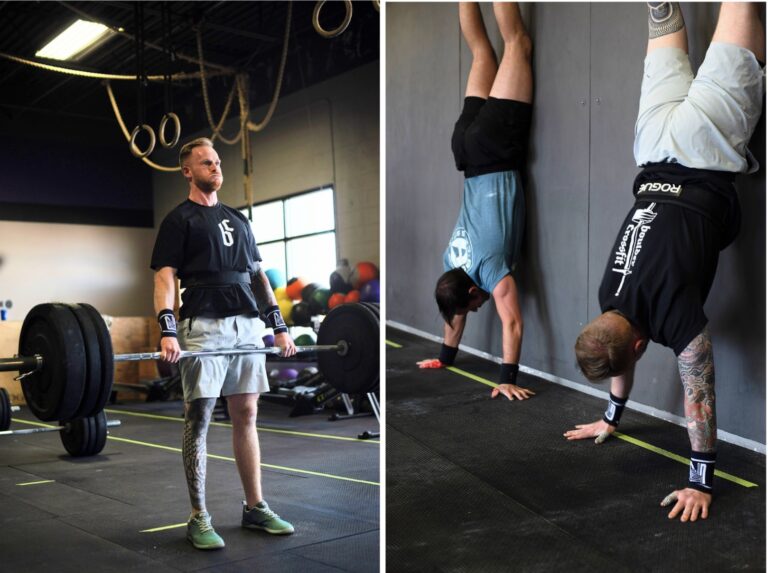
Consider an athlete who can deadlift 300 pounds for three repetitions without any back pain.
Now put 135 pounds on the bar and ask that same athlete to complete sets of 15 deadlifts throughout a 15-minute workout. Their back starts bothering them in the third or fourth round.
Did they suddenly become weak?
Probably not.
Producing a high amount of force for a few repetitions is a different physical demand than repeatedly producing force across many repetitions or sets. Maximal strength and muscular endurance are different physical qualities, and being strong during a heavy set doesn’t necessarily tell us how you’ll tolerate repeated lifting as fatigue builds. A 2024 study by Deodato and colleagues in teen gymnasts with ongoing low back pain found that their abdominals could outlast their back muscles, the kind of strength-endurance mismatch we cover in our gymnast article.
Your back may tolerate a heavy set of three. It may tolerate 10 controlled deadlifts when you’re fresh. But that doesn’t necessarily mean you’re prepared for 50 deadlifts mixed with running, rowing, burpees, or gymnastics.
Being strong doesn’t automatically mean you have the capacity to tolerate every demand of your workout.
This is why simply getting stronger, or adding more core exercises, doesn’t always address the problem. We cover what comes after core work in Moving Beyond Core Exercises.
What About Bracing?
Bracing is one strategy we can use to help manage load during lifting, and it can be especially useful during heavier or more demanding movements.
But knowing how to brace when you’re fresh is different from being able to use that strategy effectively when you’re 12 minutes into a workout.
As breathing demands increase and fatigue accumulates, maintaining the same strategy may become more challenging. This doesn’t mean you need to hold a maximal brace throughout an entire workout. Instead, athletes need to be able to adjust their breathing and trunk strategy based on the task in front of them.
If you’ve worked on bracing but your back still consistently becomes symptomatic later in workouts, the next step may not be more bracing practice.
It may be building the capacity to manage the demands of your workout as fatigue accumulates.
Should I Stop When My Back Starts Hurting?
Not necessarily.
Pain during exercise doesn’t automatically mean you’re causing damage, but that doesn’t mean you should ignore symptoms and push through everything.
Instead, pay attention to the pattern.
If your back starts to feel mildly uncomfortable after several rounds but symptoms remain stable, settle quickly afterward, and aren’t progressively worsening from workout to workout, you may be able to continue training with some modifications. This approach borrows from the pain-monitoring model Silbernagel and colleagues described in a 2007 Achilles tendinopathy study, which we apply to training with injuries in our CrossFit while injured article.
Those modifications might include reducing the weight, breaking larger sets into smaller sets, taking longer rest periods, decreasing the total number of repetitions, temporarily modifying your range of motion, slowing your pace, or substituting a movement when appropriate.
For example, if sets of 15 deadlifts consistently bring on symptoms, you may not need to remove deadlifts entirely. Breaking those sets into smaller groups, reducing the load, or changing the total volume may allow you to keep training while gradually rebuilding tolerance.
The goal is to find the appropriate dose rather than assuming your only options are to push through the pain or stop training completely. You can find more on training around back symptoms in our Back and Spine and CrossFit article archives.
How Do You Build More Capacity?
This is where rehabilitation for an active person needs to go beyond performing a few pain-free exercises in the clinic.
If your back only bothers you during minute 15 of a workout, being able to complete three sets of an exercise while rested doesn’t fully recreate the demands you’re trying to return to.
Rehab should eventually prepare you for the environment in which your symptoms actually occur. Lucas Glomb, PT, DPT, OCS, describes the same problem of under-dosed low back rehab in Creating a Resilient Lower Back.
Depending on the athlete, that progression might involve gradually increasing:
- Load: How much weight you can comfortably tolerate
- Volume: How many repetitions or sets you can complete
- Speed: How quickly you can perform movements while maintaining control
- Fatigue: How well you tolerate movements as the workout progresses
- Sport-specific demands: Combining these variables in ways that reflect your actual training
These variables don’t always need to be progressed in a specific order. The goal is to gradually increase the demands of training based on your symptoms, current abilities, and goals.
For someone who experiences low back pain during CrossFit, that might mean progressing from controlled deadlifts to higher-repetition sets, then eventually performing those movements alongside rowing, running, or other exercises. If you’re unsure whether deadlifting makes sense for you yet, our deadlifting with low back pain article covers the criteria from Berglund and colleagues’ 2015 study in the Journal of Strength and Conditioning Research.
Can you hinge after your heart rate is elevated?
Can you tolerate repeated sets without symptoms progressively increasing?
Can you lift when the clock is running and you’re moving at the pace your sport requires?
These are the types of demands that may need to be addressed before you’re fully prepared to return to your usual training.
When Should You Get Your Back Assessed?
An occasional tight or tired back after a challenging workout isn’t necessarily a reason for concern. However, if the same symptoms continue showing up every time you train, it’s worth understanding why.
Consider getting assessed if:
- Your symptoms are occurring earlier and earlier in workouts
- Pain is becoming more intense or lasting longer after training
- You’re repeatedly modifying or avoiding the same movements
- Symptoms return whenever you try to increase your training
- Pain is beginning to affect activities outside the gym
- You’re experiencing numbness, tingling, or weakness
New bowel or bladder dysfunction, saddle numbness, or rapidly progressing weakness warrant urgent medical evaluation.
Your Back Needs to Be Prepared for Your Sport
The goal of physical therapy isn’t just to make your back feel good while you’re resting.
If you want to CrossFit, run, lift, climb, ski, or participate in another demanding activity, your body needs enough capacity to handle those demands, including when you’re tired.
If your back consistently starts bothering you late in workouts, you may not need to stop doing the activities you enjoy. You may need a better plan for progressively building your tolerance to them.
At Mend Physical Therapy, we work with active adults and athletes to identify what’s limiting their training and build a plan for returning to the activities they love.
If low back pain keeps showing up when your workouts get longer, heavier, or more fatiguing, a physical therapy assessment for low back pain can help you understand what’s contributing to your symptoms and how to keep training. Book an appointment with our team.
Frequently Asked Questions
As fatigue builds, your muscles keep producing force repeatedly, your breathing changes, and different muscles may contribute more or less to the movement. Back symptoms that appear late in a workout often point to a capacity limit rather than a weak back. If it happens every time you train, an assessment can identify what is limiting you.
Not necessarily. If symptoms stay mild, settle quickly afterward, and aren’t getting worse from workout to workout, you may be able to keep training with modifications such as lighter loads, smaller sets, or longer rest. If symptoms are progressively worsening, get assessed.
Not usually. Maximal strength for a few heavy reps and muscular endurance across many reps are different physical qualities. An athlete can deadlift 300 pounds for three pain-free reps and still have symptoms during sets of 15 at 135 pounds, which points to capacity for repeated work rather than weakness.
Bracing helps manage load, but holding the same strategy gets harder as breathing demands rise and fatigue accumulates. If bracing practice hasn’t solved late-workout symptoms, the next step may be building the capacity to manage the demands of your workout, and adjusting your breathing and trunk strategy to the task.
Get assessed if symptoms show up earlier in workouts, pain is getting more intense or lasting longer, you keep modifying or avoiding the same movements, symptoms return whenever you increase training, or pain is affecting life outside the gym. Numbness, tingling, or weakness also warrant an assessment. New bowel or bladder dysfunction, saddle numbness, or rapidly progressing weakness need urgent medical evaluation.