If your shoulder has started complaining during muscle-up transitions or deep hangs, you’re not alone, and there’s still time to do something about it before the 2026 Koda Iron Games. Event 1, “Running From the Law,” pairs three 800-meter runs with gymnastics that gets harder as it goes: synchro pull-ups building to muscle-ups in RX, hand-release push-ups and chest-to-bar work in Scaled. That mix of aerobic fatigue, overhead volume, and grip demand is exactly where shoulder irritation tends to show up.
In our clinic, that irritation usually falls into one of three patterns: shoulder impingement, biceps tendinopathy, or rotator cuff related pain. This guide keeps the event breakdown short and spends most of its time on what actually helps with each one, so you can keep training and step onto the floor ready.
The Event at a Glance
| Division | Gymnastics (in sequence) | Running | Where the shoulder gets loaded |
|---|---|---|---|
| RX | Synchro pull-ups, then synchro chest-to-bar pull-ups, then muscle-ups (partners split, one on the bar and one on the rings) | 3 × 800 m | Repeated overhead pulling, the muscle-up transition, and deep hangs under fatigue |
| Masters | Same structure at the Masters gymnastics standard: pulling and muscle-up-family work | 3 × 800 m | The same overhead pulling and transitions, with less recovery tolerance between efforts |
| Scaled | Pull-ups, then synchro hand-release push-ups, then chest-to-bar pull-ups | 3 × 800 m | Combined pulling and pressing fatigue, with heavy load on the front of the shoulder |
Which Pattern Is It?
Before treating anything, it helps to know roughly what you’re dealing with. Our physical therapists have written a full breakdown of biceps tendinopathy versus shoulder impingement if you want to go deeper on the differential. The table below is for quick orientation, not self-diagnosis. Noticing where, when, and how your shoulder complains will point you to the right section below and give your physical therapist a head start.
| Pattern | What it tends to feel like | Quick self-check |
|---|---|---|
| Shoulder (subacromial) impingement | A pinch on the top or outside of the shoulder, with a painful “catch” through mid-range overhead motion and symptoms in the muscle-up transition | Slowly raise the arm out to the side. A painful band around the shoulder between roughly 60 and 120 degrees suggests impingement. |
| Biceps tendinopathy | A specific, pointable ache at the front of the shoulder with hangs, the pull off the bottom, and pressing | With your arm forward and palm up, resist a downward push. Front-of-shoulder ache and tenderness in the groove point toward biceps tendinopathy. |
| Rotator cuff related pain | Pain and weakness with overhead and rotational effort. The shoulder fatigues or “gives out” late in a set, and there’s sometimes night pain. | Full-can and resisted external-rotation holds reproduce pain or feel clearly weaker than the other side. |
How These Are Treated
The three conditions share a treatment logic, so it’s worth stating the overall approach once before the specifics. Rest alone rarely resolves them, and it tends to leave you deconditioned right before competition. The more reliable path is to calm the irritated tissue down, then progressively load it so it tolerates more.
Load management matters more than shutdown: reduce the volume and ranges that flare you while keeping the rest of your training going. When a shoulder is angry, sustained, pain-free isometric holds can dial down pain and let you keep loading through the irritable phase. From there, progressive loading is the actual medicine. Strength work, advanced gradually, is what builds tendon and rotator cuff tolerance, and it works over weeks, not days.
Use a pain-monitoring guide rather than a hard stop. Discomfort up to roughly 3 to 4 out of 10 during and after exercise, that settles by the next morning, is generally fine to work through. Sharp pain, or soreness that climbs day to day, means back off. This mirrors the pain-monitoring approach Silbernagel and colleagues described in their tendon rehabilitation research (2007, American Journal of Sports Medicine), originally studied in Achilles tendinopathy and now applied broadly across tendon and joint rehab.
Everything below is general education. A physical therapist tailors exercise selection, dosage, and progression to your shoulder, your history, and your competition timeline.
Shoulder (Subacromial) Impingement
Impingement is pain from compression of the tissues at the top of the shoulder as the arm raises and rotates. Treatment aims to reduce that irritation, restore clean overhead position, and rebuild the control that keeps the space open under load.
Calm it down
- Temporarily cut kipping, muscle-up, and high-volume overhead work. Keep strict pulling in pain-free ranges only.
- Scale muscle-ups back to their components (low-ring transitions, banded or jumping variations) rather than full reps.
- Pain-free isometric holds, shoulder external rotation at your side, and gentle scaption holds: about 5 rounds of 30 to 45 seconds, a few times a day, to settle symptoms.
Build it back up
- Scapular control: wall slides, serratus wall punches, prone or incline Y and T raises, and banded rows with a deliberate shoulder-blade squeeze.
- Rotator cuff: side-lying external rotation, banded external rotation at the side and then at 90 degrees, and full-can raises kept below the painful arc.
- Thoracic mobility: foam-roll extensions and open-book rotations to free up your overhead position.
- Progress the range and the load as your painful arc shrinks.
Back to the bar Rebuild strict pull-ups in a clean range, then controlled kipping, then gradually restore chest-to-bar and muscle-up volume as tolerance allows.
Biceps Tendinopathy (Biceps Tendonitis)
This is irritation of the long head of the biceps tendon at the front of the shoulder. Because that tendon is often aggravated alongside impingement or rotator cuff issues, good treatment loads the tendon directly and addresses the shoulder above it. Mend’s rotator cuff strengthening guide for CrossFit athletes covers that upstream work in more depth.
Calm it down
- Reduce deep-hang and heavy pulling volume. A neutral or mixed grip, or a slightly shortened bottom range, often feels cleaner in the short term.
- Isometric elbow-flexion and supination holds (for example, holding a curl position against an immovable resistance) for about 5 rounds of 30 to 45 seconds for pain relief.
Build it back up
- Progressive biceps loading: slow-tempo and eccentric curls and supination curls, advancing to heavier “heavy slow resistance” work as tolerance grows.
- Treat the driver above it: include rotator cuff and scapular work, since the biceps tendon is frequently irritated secondary to impingement or cuff overload.
- Forearm and grip-endurance work to support the hanging demands of the event.
Back to the bar Dead hangs for time, then active or scapular hangs, then strict pull-ups, then kipping and chest-to-bar as the front-of-shoulder ache settles.
Rotator Cuff Related Pain
This covers irritation, tendinopathy, or strain of the muscles that stabilize the ball in the socket. Progressive loading is the cornerstone here more than in either of the other two patterns. The cuff gets better by being asked to do gradually more, not by being protected.
Calm it down
- Trim overhead and pulling volume to what stays under your pain guide, while keeping the pushing and pulling that doesn’t flare it.
- Rotator cuff isometrics: external and internal rotation holds at your side, about 5 rounds of 30 to 45 seconds, during irritable phases.
Build it back up (the main event for the cuff)
- Isotonic cuff strength: side-lying external rotation, banded external and internal rotation, scaption and full-can raises, prone horizontal abduction (T raises), and rows.
- Progress into heavy slow resistance: controlled, genuinely challenging loads two to three times per week. A 2012 systematic review by Littlewood and colleagues in the journal Physiotherapy found moderate evidence supporting loaded exercise for rotator cuff tendinopathy.
- Scapular stabilizers (serratus and lower-trap work) to give the cuff a stable base to pull from.
Back to the bar Reintroduce hanging and pulling volume gradually. Watch for the late-set fatigue or “giving out” feeling; it should improve as cuff capacity builds.
A Note on Hands-On Treatment
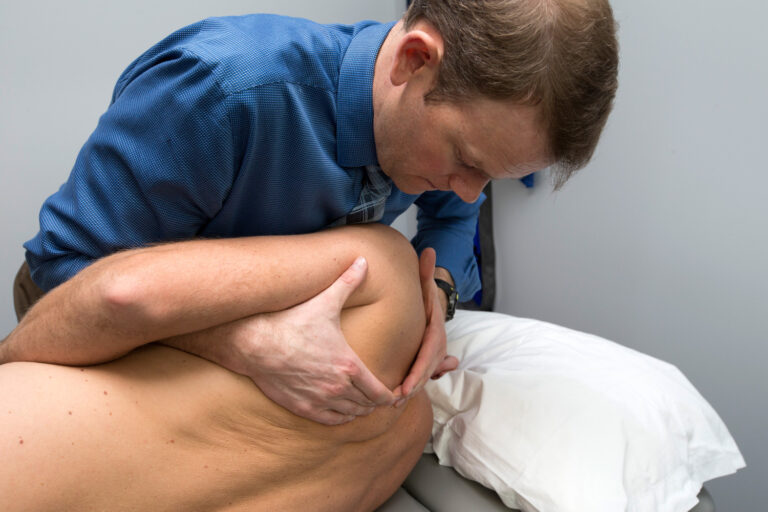
Manual therapy, soft-tissue work, dry needling, and mobility drills can meaningfully calm symptoms in the short term, especially early, when the shoulder is irritable. They work best as a complement to loading, not a replacement for it. Mend’s manual therapy and dry needling tag pages cover how our clinicians use these tools alongside the strength and capacity work above, which is what actually changes how much your shoulder can tolerate over the coming weeks.
Red Flags: When to Stop Self-Managing and Get Seen
See a physical therapist or physician sooner rather than later if you have obvious weakness that keeps you from raising or holding your arm overhead, an arm that drops uncontrollably when you try to lower it slowly from overhead, pain following a specific fall or jerk on the bar, numbness or tingling into the arm or hand, significant night pain, or pain that keeps getting worse week over week despite backing off. These findings don’t necessarily mean something serious, but they’re worth ruling out before you load the shoulder further.
Come See Us Before Competition Weekend
If shoulder pain has you concerned about how you’ll prepare or compete, come see us at Mend. We’re offering Training Room Hours leading up to Koda Iron Games to help athletes address pain and injuries before competition weekend. Training through pain for the next several weeks and waiting until after Koda to deal with it is the wrong trade. Now is the time to figure out what’s driving your symptoms and exactly how to treat it.
Our physical therapists can build a plan around the treatments above, tailored to your shoulder and your timeline, and keep you training when appropriate. Book an appointment and let’s get you to the competition floor ready.
FAQs
In many cases, yes, with modifications. Whether Event 1 is safe to attempt as programmed depends on which pattern you’re dealing with and how irritable it currently is. A physical therapist can help you decide what to load in the time you have left and what to scale.
As soon as you notice it. Most of the patterns above respond to a few weeks of targeted treatment, but that window closes fast the closer you get to competition weekend. Waiting until after Koda means training through pain you could have addressed now.
Taping and bracing can reduce symptoms temporarily, but they don’t change tissue tolerance. They’re reasonable as a short-term tool during competition itself, not as a substitute for the loading work described above in the weeks beforehand.