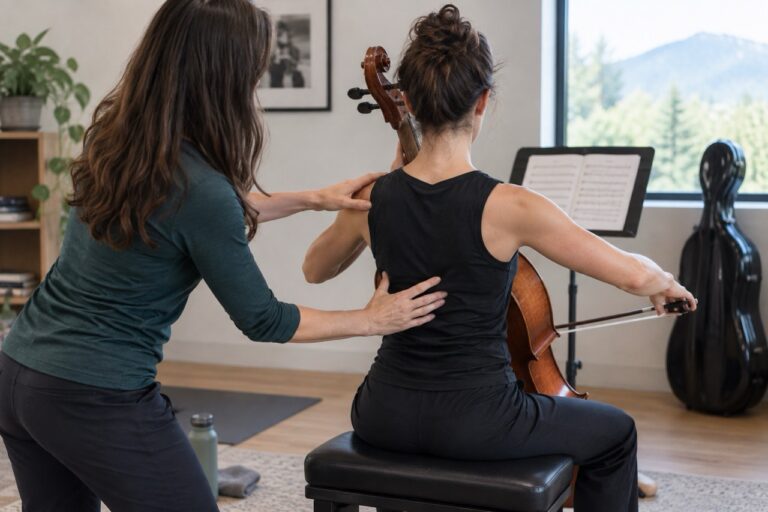

You finish a long rehearsal and your neck is tight, your shoulder is burning, and the space between your shoulder blades feels like a knot. Maybe it settles overnight. Then you pick up your instrument the next day and it’s right back.
If that sounds familiar, you’re in good company. Neck and shoulder pain is one of the most common musculoskeletal complaints among musicians. It doesn’t mean you’re doing something wrong as a musician. Your body is asking for more support than it currently has, and you don’t necessarily have to stop playing to give it that.
How Common Is Neck and Shoulder Pain in Musicians?
A 2016 systematic review by Kok and colleagues in the International Archives of Occupational and Environmental Health pooled 21 studies including 5,424 professional musicians. The 12-month prevalence of musculoskeletal complaints ranged from 41% to 93%, with the neck and shoulders among the most commonly affected areas. Most of the included studies found higher rates in women.
The physical demands differ by instrument, but neck and shoulder pain can affect violinists, guitarists, pianists, drummers, singers, wind players, and many other performers. Frequent pain isn’t something you have to live with. For a broader look at how musicians load their bodies, see our guide to physical therapy for musicians in Boulder.
Why Do Musicians Develop Neck and Shoulder Pain?
Neck and shoulder pain is rarely as simple as “bad posture.” More often, there’s a mismatch between what your instrument demands and the physical capacity you’ve built to meet those demands.
Playing an instrument can require:
- Holding sustained positions for long periods
- Repeating the same movements thousands of times
- Maintaining your head and neck in a relatively fixed position
- Working one side of the body more than the other
- Supporting the weight of an instrument
- Maintaining shoulder and arm positions while your hands perform precise movements
- Practicing or performing for long periods with limited recovery
The demands also vary significantly by instrument. A violinist may spend hours holding the head and neck in a sustained, asymmetrical position. A guitarist may spend long periods sitting with the arms positioned in front of the body. A pianist may maintain a relatively fixed trunk and shoulder position while performing rapid, repetitive hand movements.
Your instrument isn’t necessarily “causing” your pain, but your rehabilitation should account for the demands of your specific instrument and playing style.
Is Poor Posture Causing Your Musician Neck Pain?
Probably not by itself. It’s easy to blame neck and shoulder pain on posture, but there is rarely one “perfect” position that prevents pain. A 2016 review in Manual Therapy by Barrett and colleagues, covered in our post on the influence of posture on shoulder function and pain, found moderate evidence that thoracic posture did not differ between people with and without shoulder pain. The authors concluded that thoracic posture did not significantly contribute to the development of future shoulder pain.
Instead of trying to hold yourself in a perfectly upright position throughout an entire rehearsal, it can be more useful to develop the strength, mobility, and endurance to comfortably move between different positions. You can find more in our posture articles.
3 Exercises for Musician Neck and Shoulder Pain
These exercises are a good place to start building the strength, control, and mobility you need for playing. Before you play, our 5-minute warm-up for musicians is a good way to get ready.
1. Wall Slide With Lift-Off
Slide your arms up a wall, then gently lift your hands away from the wall while maintaining control.
This strengthens the muscles around your shoulder blades and helps improve how your shoulder joint moves with your shoulder blade to support your arms while you play.
2. Seated Chin Tuck With Resistance
Using a resistance band behind your head, gently press backward into the band while drawing your chin back.
This exercise targets the deep muscles that help stabilize your neck and can help improve neck control during prolonged playing. Research on these muscles is summarized in our post on deep neck flexor weakness and neck pain. A 2018 study in Pain Medicine by Arimi and colleagues found smaller deep cervical muscles and lower endurance in people with chronic neck pain, and deep cervical flexor weakness was a significant predictor of chronic neck pain development.
3. Half-Kneeling Thoracic Rotation With Band Pull-Apart
From a half-kneeling position, rotate through your upper back while pulling the band apart.
This combines upper-back mobility with scapular strength, helping your upper back and shoulders share the workload instead of relying primarily on your neck. For more ways to loosen the upper back, see our thoracic mobility exercises.
Watch the video below to see how to perform all three exercises.
These exercises are a general starting point, not a substitute for an individualized evaluation. Your ideal exercise program will depend on your instrument, playing demands, symptoms, strength, and mobility. Our neck and shoulder archives have more, and you can browse all Orthopedic Care articles.
When Should a Musician See a Physical Therapist?
Some soreness after an unusually long rehearsal isn’t necessarily a problem. But if your symptoms keep returning or are interfering with your ability to play, it’s worth getting evaluated.
Consider seeing a physical therapist if you experience:
- Neck or shoulder pain that repeatedly returns when you play
- Pain that progressively builds during practice or rehearsal
- Pain that lingers after you stop playing
- Shoulder or upper back tightness that limits your playing
- Headaches that consistently occur while playing
- A decrease in playing endurance
- Changes in coordination or control
- Numbness or tingling in your arm or hand
- Weakness in your arm or hand
Numbness, tingling, or weakness should not simply be pushed through. These symptoms can indicate nerve involvement and deserve an appropriate evaluation.
Frequently Asked Questions
Violin playing can hold the head and neck in a sustained, asymmetrical position for hours. That load builds over a long rehearsal, especially when recovery time is limited.
Probably not by itself. There is rarely one perfect position that prevents pain, and pain more often reflects a mismatch between what your instrument demands and the strength, mobility, and endurance you’ve built.
You don’t necessarily have to stop playing to address it. If the pain keeps returning, builds as you practice, or comes with numbness, tingling, or weakness, get it evaluated.
A good starting point is strengthening around the shoulder blades, training the deep neck muscles, and improving upper-back rotation. The wall slide with lift-off, seated chin tuck with resistance, and half-kneeling thoracic rotation with band pull-apart above cover each.
Physical Therapy for Musicians in Boulder, CO
If you’re a musician in Boulder dealing with neck pain, shoulder pain, or upper back pain, you don’t have to choose between playing and feeling better.
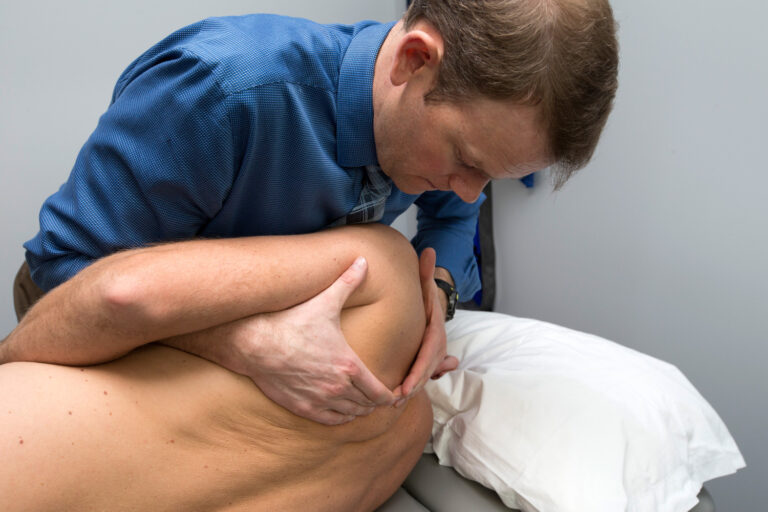
At Mend, we work with musicians as the skilled performers they are. Your evaluation may include your strength, mobility, endurance, playing position, instrument-specific demands, and practice habits. From there, we can build a rehabilitation plan around what you actually need to do as a musician. Our pages on neck pain treatment and shoulder pain treatment explain how we approach each.
As a physical therapist and fellow musician, my goal is to help you play with less pain, more endurance, and more confidence. You can read more about me on my bio page.
Book an appointment with Dr. Mary Pezzella, PT, DPT at Mend in Boulder, CO.
References
Kok, L. M., Huisstede, B. M. A., Voorn, V. M. A., Schoones, J. W., & Nelissen, R. G. H. H. (2016). The occurrence of musculoskeletal complaints among professional musicians: A systematic review. International Archives of Occupational and Environmental Health, 89(3), 373-396. https://doi.org/10.1007/s00420-015-1090-6