Most people expect a sprained ankle to settle on its own, and many do. But in a survey of 467 patients seen for an ankle sprain in a general clinic, 72.6% still reported symptoms 6 to 18 months later (Braun, 1999). Pain, giving way, and repeat sprains are the problems that bring people to us, often years after the first injury.
This article covers how acute sprains are treated now, why some ankles keep giving way, and what physical therapy for chronic ankle instability involves.
From R.I.C.E. to a movement approach
My approach to treating ankle sprains has changed dramatically since I began working with athletes in the late 1990s. The P.R.I.C.E. approach (protection, rest, ice, compression, and elevation) controlled pain and swelling but did little to reduce recurrence. It has been replaced with an active approach built around early movement, manual therapy, and exercise.
The 2021 clinical practice guideline from the Academy of Orthopaedic Physical Therapy supports that shift (Martin et al., JOSPT, 2021). For an acute lateral ankle sprain it recommends progressive weight bearing with a brace or tape, a structured exercise program that includes balance training, and manual therapy combined with exercise (all grade A). Ice may be used alongside exercise (grade C). Therapeutic ultrasound should not be used (grade A).
A 2017 overview in the British Journal of Sports Medicine pooled 46 papers on ankle sprain treatment and prevention. It found strong evidence for early mobilization, moderate evidence for exercise and manual therapy, and strong evidence that bracing helps prevent recurrent sprains (Doherty et al., 2017).
Most sprains involve the ligaments on the outside of the ankle, when the foot rolls inward under the shin. A sudden inability to bear weight, or tenderness over the bone, needs an exam to rule out a fracture before rehab begins.
Why ankle sprains keep coming back
The stability of a joint comes from three systems: passive structures (bone shape and ligaments), active structures (muscles and tendons), and the neuromuscular system that controls balance and proprioception. Together they support the joint in both healthy and sprained conditions. An injury to one system, such as a sprained ligament, can be compensated by improvements in strength or balance. Athletes who return to full sport after a sprain, sometimes called copers, are likely doing exactly that. In one cohort followed in the 2021 guideline, 60% of people with a lateral ankle sprain became copers and 40% developed chronic ankle instability.
The term instability describes persistent pain, giving way, or loss of function after a sprain. For years we blamed it on a stretched-out ligament. A study of Division I athletes in the Clinical Journal of Sport Medicine called that into question (Liu et al., 2013). Each athlete reported their number of prior sprains on each ankle, then had ligament laxity measured in three directions with an ankle arthrometer. The authors found no relationship between laxity and the number of sprains, and no significant difference in laxity between injured and uninjured ankles.
Some studies have linked laxity to recurrent sprains, so ligaments are part of the picture. But patients with giving way often have greater deficits in strength and balance than in ligament stability. It is common to find balance impairments on both sides after a one-sided ankle sprain, which points to a change in how the central nervous system controls posture on unstable surfaces. Reaction time shows the same pattern. A review of 25 studies using a sudden ankle inversion test found that the peroneal muscles on the outside of the leg were slower to react in people with ankle injuries than in people without them (Menacho et al., 2010). On a trail or a court, that delay can be the difference between a stumble and another sprain. We do not know whether these changes cause the sprain or follow it, but leaving the muscular and neuromuscular systems unrehabilitated likely leaves the ankle at greater risk.
Who is at risk for a first sprain or a repeat
Higher body weight, weakness in the leg and ankle muscles, and limited balance raise the risk of a first sprain. In 539 high school and college football players, poor forward reach on the Star Excursion Balance Test predicted who sprained an ankle during the season, and injured players had higher BMI (Gribble et al., 2016). The hip matters too: we see hip weakness in many patients after a sprain, and prospective research suggests it may be present beforehand (see hip weakness as a predictor of ankle sprains and athletes with hip weakness experience twice as many ankle sprains).
We can also spot who is likely to struggle after a first sprain. Doherty and colleagues followed 82 people from their first lateral ankle sprain through 12 months. Those who could not complete a single-leg drop landing and a drop vertical jump at 2 weeks were more likely to develop chronic ankle instability, and balance reach deficits at 6 months were the strongest predictor (Doherty et al., 2016). That is why we test landing and balance early instead of waiting to see how the ankle feels.
Physical therapy for chronic ankle instability
For chronic ankle instability, the 2021 guideline recommends manual therapy (joint mobilization, manipulation, and weight-bearing mobilization) to improve ankle dorsiflexion and dynamic balance in the short term, and proprioceptive and neuromuscular training to improve stability during activity (both grade A). Balance training is the core of treatment, combined with manual therapy and exercise tailored to the patient’s goals (grade B). A brace or tape alone should not be used to improve balance (grade B).
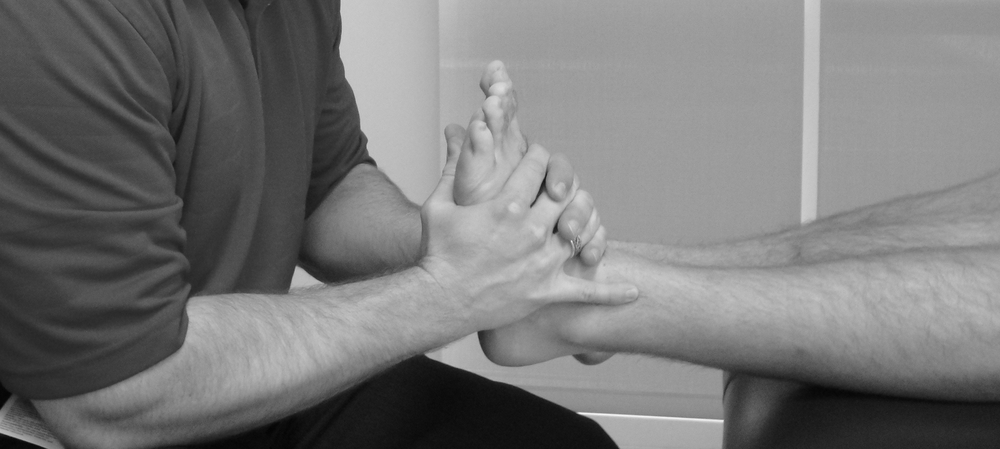
A 2020 appraisal in the Journal of Sport Rehabilitation looked at three randomized trials comparing exercise with and without manual therapy. Two of the three found better patient-reported outcomes when manual therapy was added (Walsh et al., 2020). In practice, we use manual therapy to restore normal joint mobility, then progress to higher-level exercise for strength, balance, and sport-specific movement.
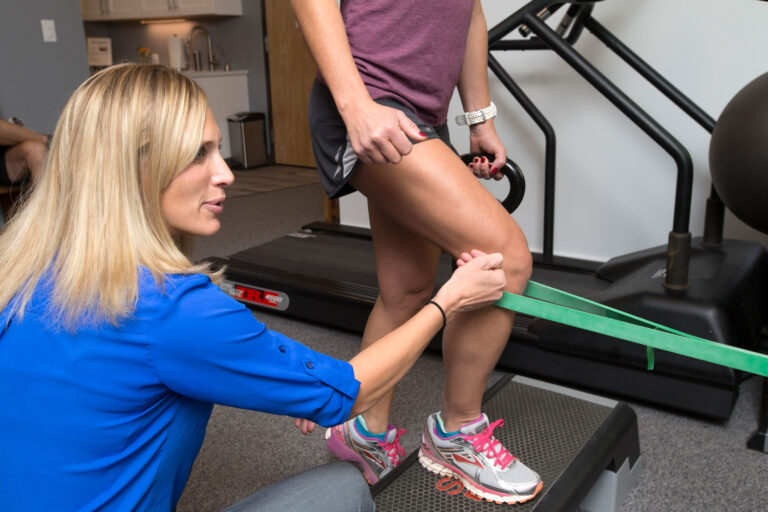
Ankle instability exercises progress from single-leg balance to reaching, hopping, and landing tasks, and finally to the cutting, jumping, or edging your sport demands. Before return to sport we look for side-to-side symmetry on balance and hop testing. Climbers and fighters have their own demands; see ankle sprains in rock climbers and ankle sprains in Muay Thai.
When to see a physical therapist
See a physical therapist soon after a sprain if you cannot hop or land on the injured side, and any time an ankle keeps giving way. If you have sprained the same ankle more than once, book an ankle instability evaluation and we will test your balance, strength, and landing mechanics and build a plan to stop the cycle. More on this topic in our Ankle and Foot articles and our manual therapy approach.
Frequently asked questions
Balance and neuromuscular training is the core of treatment, combined with manual therapy to restore ankle mobility. The 2021 JOSPT guideline gives both a grade A recommendation for chronic ankle instability.
Yes. The 2021 guideline recommends progressive weight bearing, a structured exercise program with balance training, and manual therapy combined with exercise for acute sprains (grade A).
Repeat sprains are usually tied to deficits in balance, strength, and neuromuscular control more than a loose ligament. A study of Division I athletes found no relationship between ligament laxity and the number of sprains.
Single-leg balance, reaching tasks such as the Star Excursion Balance Test, hopping, and landing drills, progressed toward the movements your sport requires. A physical therapist sets the starting level and progression.
Ice and compression can help with early pain and swelling, but rest alone is not enough. Early weight bearing and exercise lead to better recovery and fewer repeat sprains.
References
- Braun BL. Effects of ankle sprain in a general clinic population 6 to 18 months after medical evaluation. Arch Fam Med. 1999;8(2):143-148. PubMed
- Martin RL, Davenport TE, Fraser JJ, Sawdon-Bea J, Carcia CR, Carroll LA, Kivlan BR, Carreira D. Ankle stability and movement coordination impairments: lateral ankle ligament sprains revision 2021. J Orthop Sports Phys Ther. 2021;51(4):CPG1-CPG80. doi:10.2519/jospt.2021.0302
- Doherty C, Bleakley C, Delahunt E, Holden S. Treatment and prevention of acute and recurrent ankle sprain: an overview of systematic reviews with meta-analysis. Br J Sports Med. 2017;51(2):113-125. PubMed
- Liu W, et al. Increased frequency of ankle sprain does not lead to an increase in ligament laxity. Clin J Sport Med. 2013. doi:10.1097/JSM.0b013e31829afc03
- Gribble PA, Terada M, Beard MQ, et al. Prediction of lateral ankle sprains in football players based on clinical tests and body mass index. Am J Sports Med. 2016;44(2):460-467. doi:10.1177/0363546515614585
- Doherty C, Bleakley C, Hertel J, Caulfield B, Ryan J, Delahunt E. Recovery from a first-time lateral ankle sprain and the predictors of chronic ankle instability: a prospective cohort analysis. Am J Sports Med. 2016;44(4):995-1003. PubMed
- Walsh BM, Bain KA, Gribble PA, Hoch MC. Exercise-based rehabilitation and manual therapy compared with exercise-based rehabilitation alone in the treatment of chronic ankle instability: a critically appraised topic. J Sport Rehabil. 2020;29(5):684-688. doi:10.1123/JSR.2019-0337
- Menacho MO, Pereira HM, de Oliveira BIR, et al. The peroneus reaction time during sudden inversion test: systematic review. J Electromyogr Kinesiol. 2010;20(4):559-565. doi:10.1016/j.jelekin.2009.11.007