Yes, for most people. If knee arthritis limits your stairs, your squats, or a day on the trail, physical therapy is where most guidelines tell you to start, and the trial evidence behind it is stronger than most people expect. Exercise does most of the work. Manual therapy has a real but smaller role, and the research does not support overselling it.
What knee arthritis feels like
Knee osteoarthritis usually shows up as pain with activity, stiffness after sitting or first thing in the morning, sometimes swelling, and trouble with stairs, squatting, or long walks. The knee is the most common site of osteoarthritis, which affected an estimated 595 million people worldwide in 2020 according to a Global Burden of Disease analysis in The Lancet Rheumatology, and it becomes more common with age, most often after 40.
See a physical therapist if pain with weight-bearing is persistent, if stiffness or swelling limits how far the knee moves, or if you have noticed a drop in strength or balance.
What physical therapy does for knee arthritis
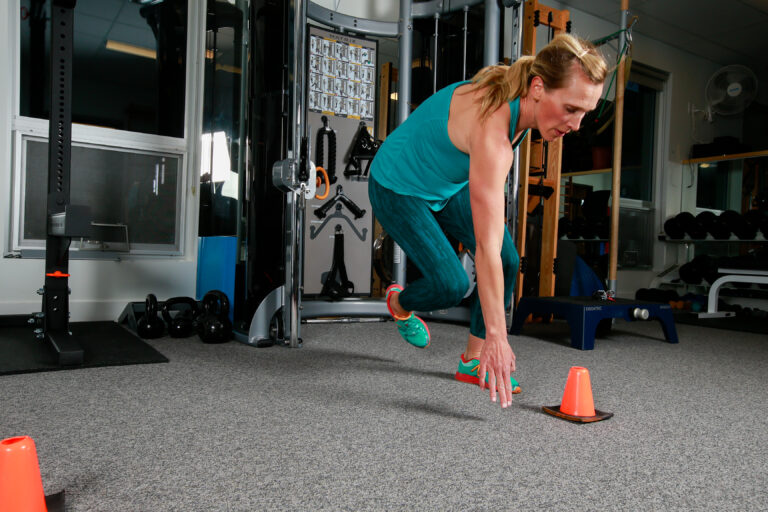
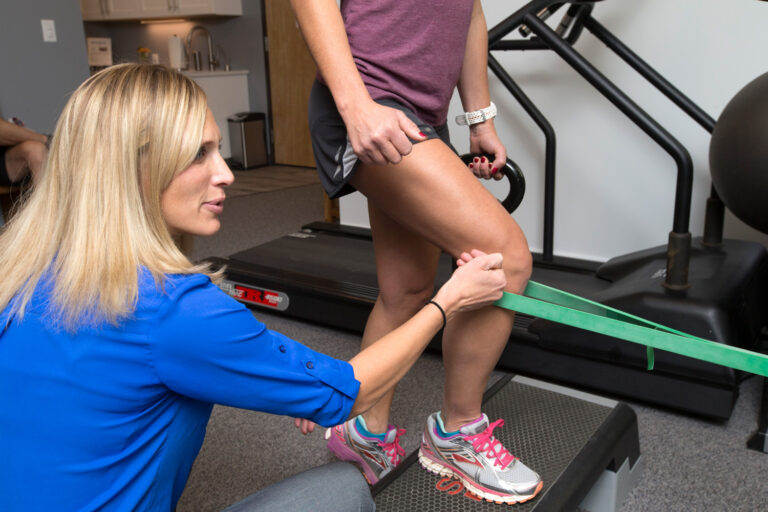
A course of physical therapy for knee arthritis centers on a progressive exercise program, hands-on work to ease pain and stiffness, and coaching on how to load the knee between visits. Exercise is the anchor. That caveat is why supervision and progression matter. We build the program around what your knee tolerates now, and we cover the dosing question in how much exercise you need each week to improve knee arthritis. If you worry that exercise will make arthritis worse, we address that directly in Will Exercise Worsen My Knee Arthritis?
Where manual therapy fits
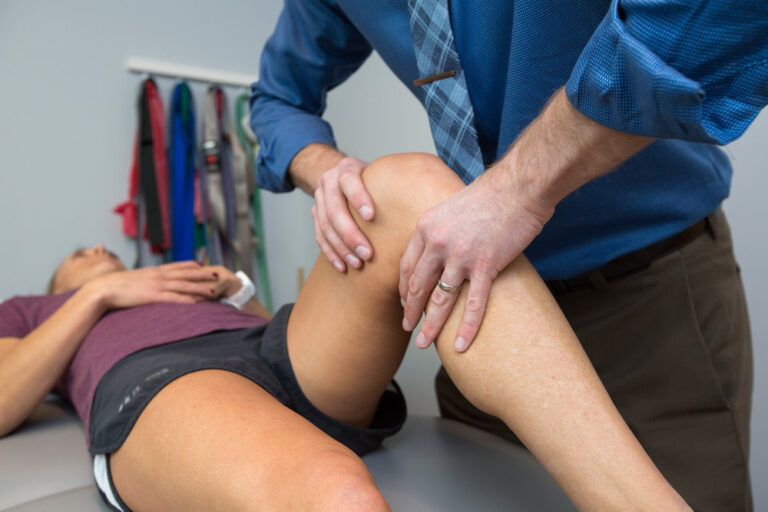
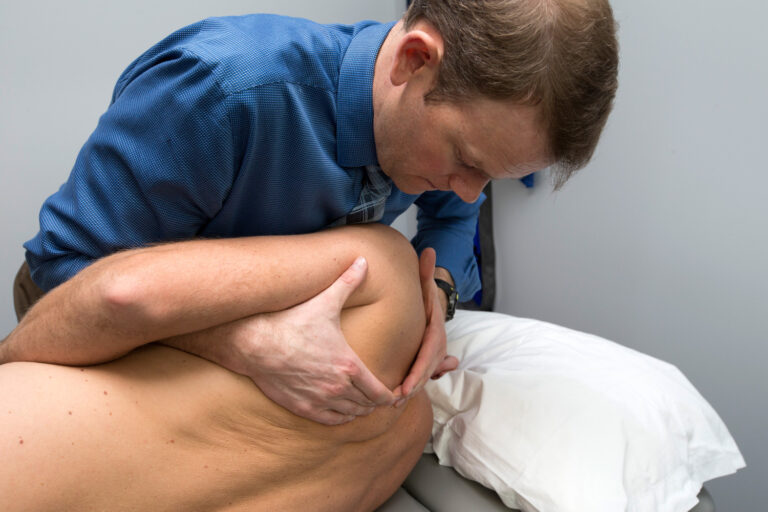
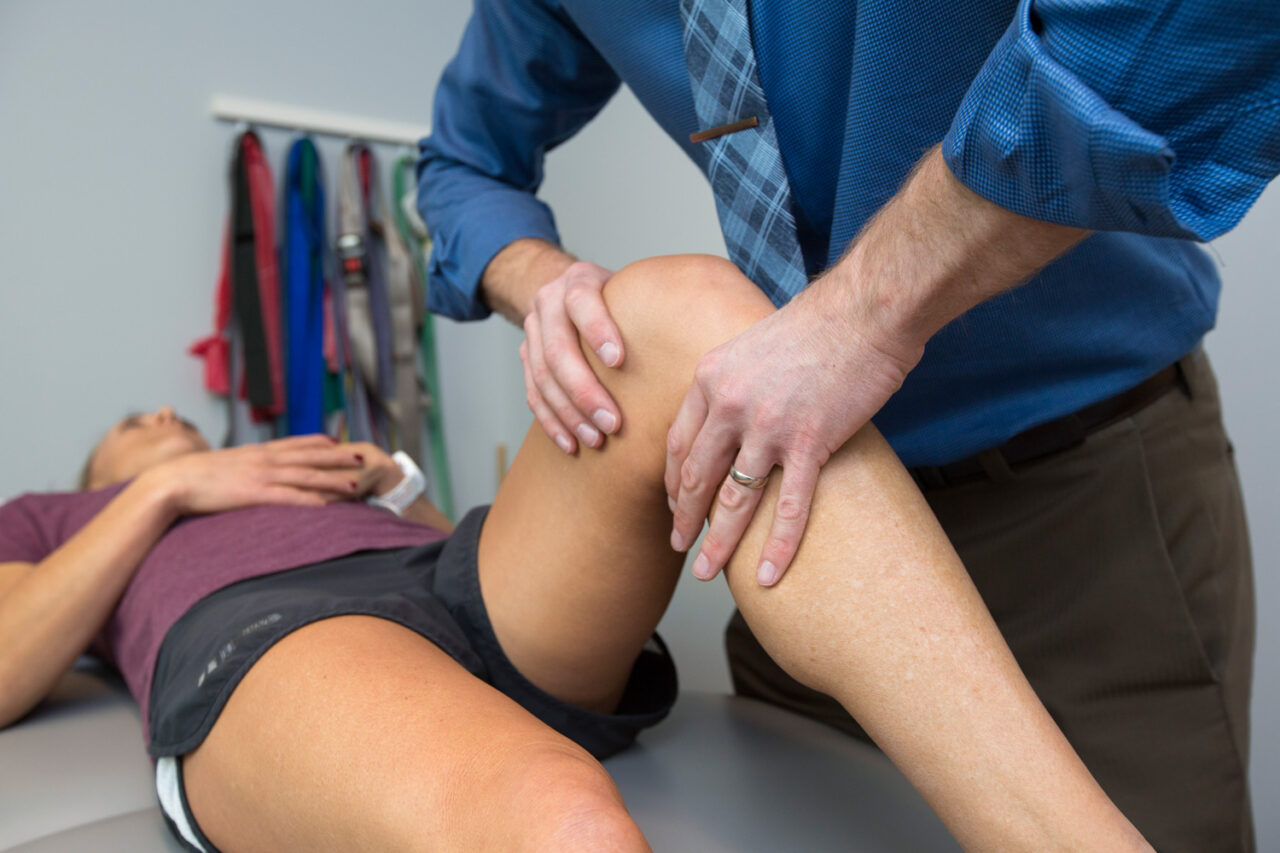
Manual therapy, meaning hands-on joint mobilization and soft tissue work, is what separates a clinic course from a home program in the best-known trials. Deyle and colleagues ran those trials, and their therapists treated the knee and, when needed, the hip, lumbar spine, and ankle.
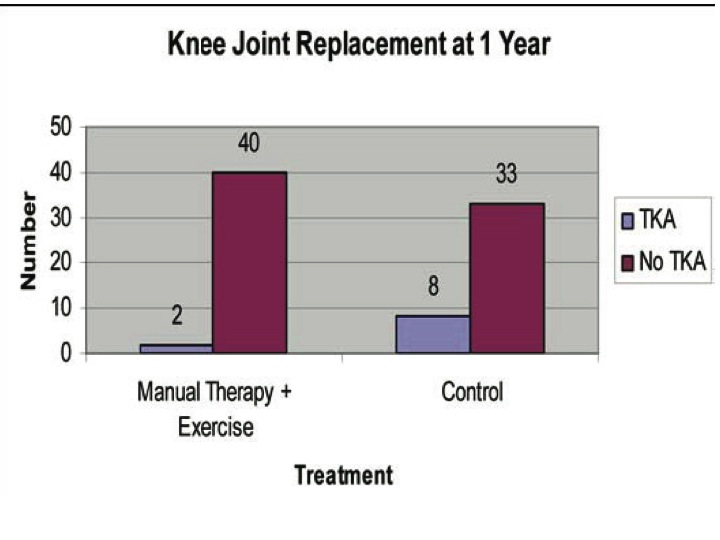
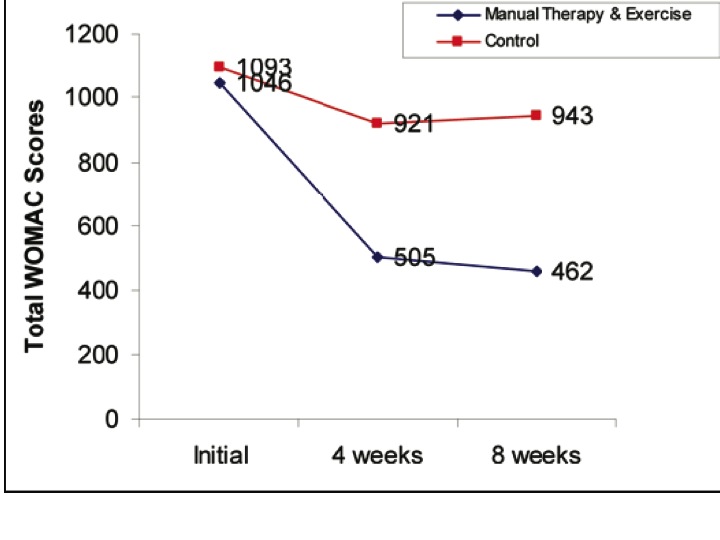
In a 2000 Annals of Internal Medicine trial of 83 patients, manual therapy plus a supervised knee exercise program beat a placebo treatment. At eight weeks, WOMAC scores, a standard questionnaire covering pain, stiffness, and function, had improved 55.8% over baseline in the treated group. At one year, 5% of treated patients had undergone knee replacement compared with 20% of the placebo group. That is the basis for saying physical therapy may delay or prevent surgery, and “may” is the right word for a trial that size.
A 2005 trial in Physical Therapy compared four weeks of supervised exercise plus individualized manual therapy against a home exercise program in 134 people. WOMAC scores improved 52% in the clinic group and 26% in the home group at four weeks. By one year both groups had improved by about the same amount, which the authors attributed to everyone continuing the same home exercises.
The MOA trial in New Zealand randomized 206 adults with hip or knee osteoarthritis to nine one-hour sessions of manual therapy, exercise therapy, both, or usual care alone. At one year, manual therapy and exercise therapy each improved pain and function over usual care, and the combination did no better than either one alone.
The most recent pooled evidence is less generous. A 2022 meta-analysis in JOSPT of 19 trials by Runge and colleagues found very low to moderate certainty that adding manual therapy to exercise reduces short-term pain, no added benefit for function, and high-certainty evidence of no added benefit over exercise alone in the long term. The long-term finding rests on only three trials, and other researchers have argued that short-term relief still has value. Our approach follows from that: we use manual therapy to bring pain and stiffness down early so you can do the exercise that carries the long-term result. For a closer look at the technique, see our guide to knee mobilization, and browse the Manual Therapy library for other joints.
How physical therapy compares with a cortisone injection
A 2020 New England Journal of Medicine trial by Deyle and colleagues randomized 156 people with knee arthritis to physical therapy, which included manual therapy and exercise, or to a glucocorticoid injection. At one year, WOMAC scores averaged 37.0 in the physical therapy group and 55.8 in the injection group, where lower is better. The physical therapy course was about eight visits over four weeks.
A 2022 analysis of the same trial found physical therapy cost-effective compared with injection. Total knee-related costs at one year were equivalent, and the physical therapy group gained more quality-adjusted life-years. We summarize the trial in Physical Therapy Found Superior to Steroid Injection for Knee Arthritis. Injections and physical therapy are not mutually exclusive, and your physician and PT can coordinate the two.
What treatment looks like at Mend
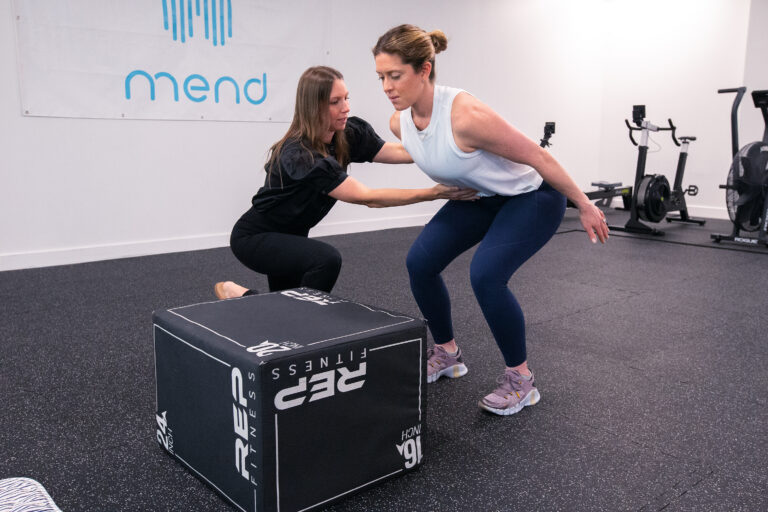
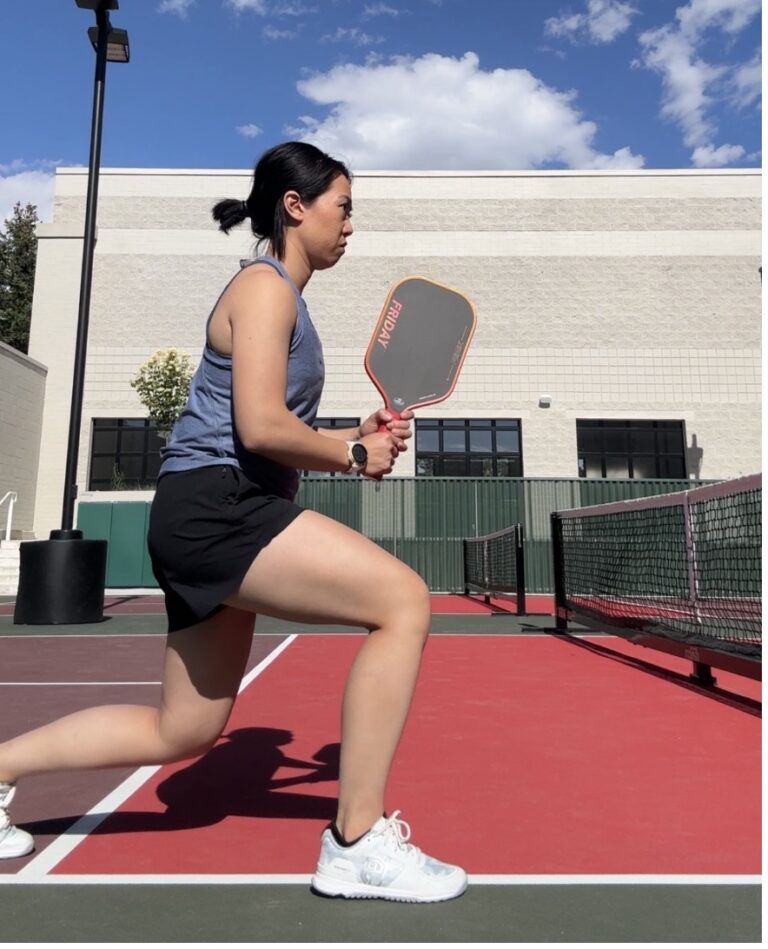
We start by measuring what your knee can and cannot do: how far it bends and straightens, how it handles a squat and a step down, and how your hip and ankle contribute. Treatment then combines joint mobilization when stiffness or pain is the limiter, a progressive strength plan, and guidance on pacing your activity. Some patients also do well with dry needling, which we cover in dry needling and knee arthritis. If you play racquet sports, how to keep playing tennis and pickleball with knee arthritis covers the on-court side.
Most people have a series of visits over several weeks with a home program, then check-ins to progress it. Browse our Knee articles for the research behind individual pieces of the plan.
When to get checked before starting
Most knee arthritis is safe to start treating without further testing. See a physician first if the knee is hot, red, and swollen, if it feels locked, for any trauma including fall or twist, or any symptoms of infection or illness. A swollen joint with a fever needs same-day medical care.
Frequently asked questions
Yes. Exercise is recommended by every current international guideline, and clinic-based physical therapy including manual therapy outperformed a home program at four weeks and an injection at one year in the Deyle trials. Results depend on doing the exercise, so they vary from person to person.
In the 2020 New England Journal of Medicine trial, people who did physical therapy had better WOMAC scores at one year than people who received a glucocorticoid injection, 37.0 versus 55.8. Costs were similar at one year. Injections can still ease a flare, and they can be combined with physical therapy.
It can help pain in the short term. A 2022 meta-analysis found very low to moderate certainty evidence for short-term pain relief when manual therapy is added to exercise, and no added long-term benefit over exercise alone. We use it to make exercise easier, not as a stand-alone treatment.
It may. In a 2000 trial of 83 patients, 5% of the manual therapy and exercise group had a knee replacement within a year, compared with 20% of the placebo group. That was a small study, so treat it as a reason to try physical therapy first, not a guarantee.
The 2020 trial used about eight visits over four weeks, and the 2005 trial used a four-week clinic program. Your number depends on pain, strength, and goals, and we set it after your first evaluation.
If knee arthritis is limiting stairs, squats, or long walks and you have not had a supervised exercise plan, book a knee evaluation at mendcolorado.com. We measure your motion and strength, explain what is driving your symptoms, and build a program you can follow at home. You can see how we approach knee pain at our Boulder and Lafayette clinics on our knee pain treatments page.
References
- Deyle GD, Henderson NE, Matekel RL, Ryder MG, Garber MB, Allison SC. Effectiveness of manual physical therapy and exercise in osteoarthritis of the knee: a randomized, controlled trial. Ann Intern Med. 2000;132(3):173-181.
- Deyle GD, Allison SC, Matekel RL, Ryder MG, Stang JM, Gohdes DD, et al. Physical therapy treatment effectiveness for osteoarthritis of the knee: a randomized comparison of supervised clinical exercise and manual therapy procedures versus a home exercise program. Phys Ther. 2005;85(12):1301-1317.
- Abbott JH, Robertson MC, Chapple C, Pinto D, Wright AA, Leon de la Barra S, et al. Manual therapy, exercise therapy, or both, in addition to usual care, for osteoarthritis of the hip or knee: a randomized controlled trial. 1: clinical effectiveness. Osteoarthritis Cartilage. 2013;21(4):525-534.
- Pinto D, Robertson MC, Hansen P, Campbell AJ, Abbott JH. Manual therapy, exercise therapy, or both, in addition to usual care, for osteoarthritis of the hip or knee. 2: economic evaluation alongside a randomized controlled trial. Osteoarthritis Cartilage. 2013;21(10):1504-1513.
- Runge N, Aina A, May S. The benefits of adding manual therapy to exercise therapy for improving pain and function in patients with knee or hip osteoarthritis: a systematic review with meta-analysis. J Orthop Sports Phys Ther. 2022;52(10):675-684. doi:10.2519/jospt.2022.11062
- Deyle GD, et al. Physical therapy versus glucocorticoid injection for osteoarthritis of the knee. N Engl J Med. 2020;382:1420-1429. doi:10.1056/NEJMoa1905877
- Rhon DI, et al. Cost-effectiveness of physical therapy vs intraarticular glucocorticoid injection for knee osteoarthritis: a secondary analysis from a randomized clinical trial. JAMA Netw Open. 2022;5(1):e2142709.
- Steinmetz JD, et al. Global, regional, and national burden of osteoarthritis, 1990-2020 and projections to 2050: a systematic analysis for the Global Burden of Disease Study 2021. Lancet Rheumatol. 2023;5:e508.
- Fernandes L, Hagen KB, Bijlsma JW, Andreassen O, Christensen P, Conaghan PG, et al. EULAR recommendations for the non-pharmacological core management of hip and knee osteoarthritis. Ann Rheum Dis. 2013;72:1125-1135.
- Zhang W, Moskowitz RW, Nuki G, Abramson S, Altman RD, Arden N, et al. OARSI recommendations for the management of hip and knee osteoarthritis, part II: OARSI evidence-based, expert consensus guidelines. Osteoarthritis Cartilage. 2008;16:137-162.
- Larmer PJ, et al. Systematic review of guidelines for the physical management of osteoarthritis. Arch Phys Med Rehabil. 2014;95:375-389.
- Jamtvedt G, et al. Physical therapy interventions for patients with osteoarthritis of the knee: an overview of systematic reviews. Phys Ther. 2008;88(1).