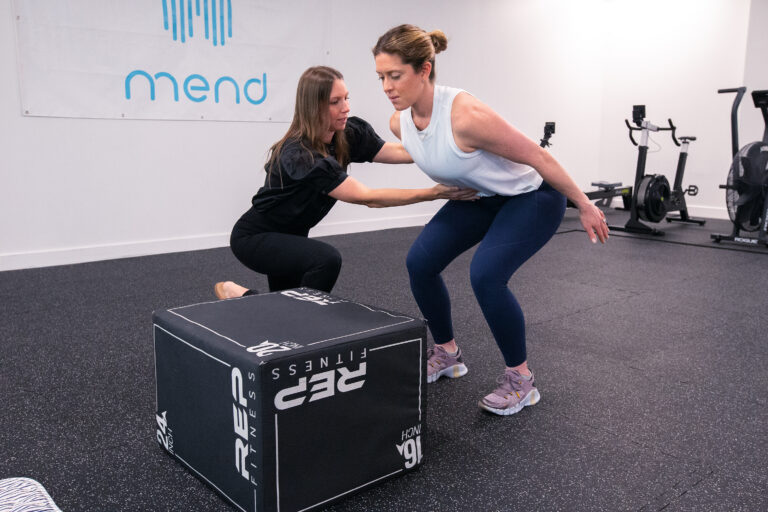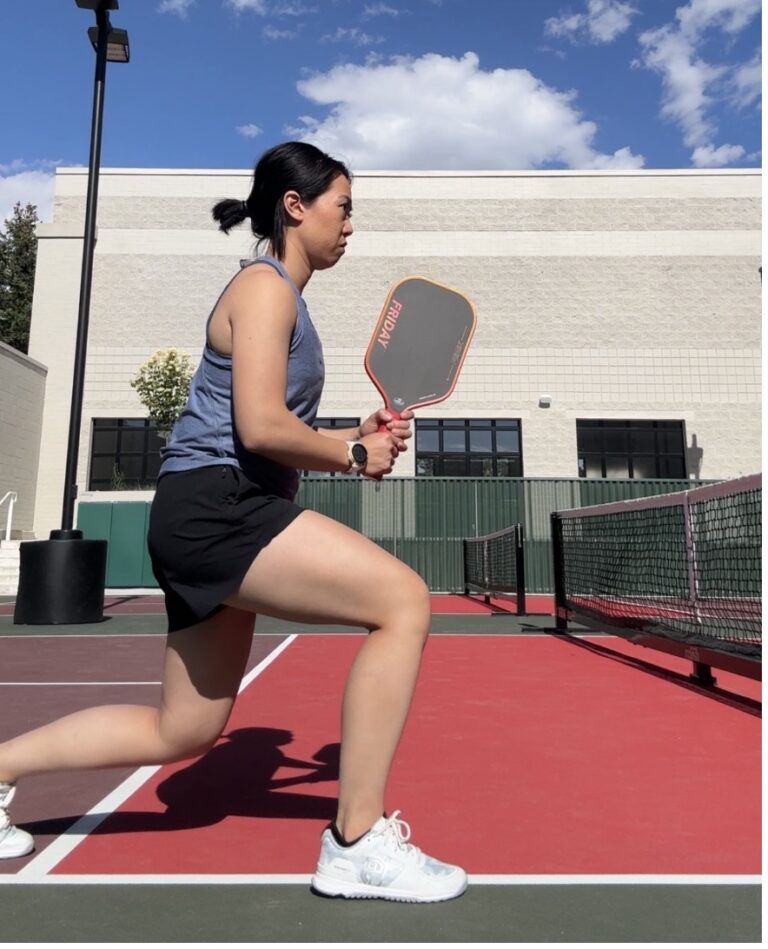

One of our favorite tools at Mend Colorado for improving hip mobility is a heavy duty Rogue resistance band. If you often feel like one hip is “tight,” your squat feels blocked, or you can’t access a position you need for running, climbing, lifting, or everyday life, a Rogue-style loop band can be a useful self-mobilization tool when it is used gently, purposefully, and followed by active movement and strengthening to reinforce and improve mobility.
This approach builds on the technique we cover more broadly in our guide to banded joint mobilizations at home. Here, we’re going deeper on the hip specifically and matching each mobilization to the sport or activity it’s meant to prepare you for.
What Does a Multi-Directional Hip Mobilization Look Like?

With a heavy resistance band anchored securely at a low point, you can position the band high around the hip and step away to create a gentle pulling force. From there, move through several directions depending on the restricted motion you’re trying to address:
- Hip flexion: Think deep squatting or bringing your knee toward your chest.
- Hip extension: Think walking, running, or driving the leg backward.
- Hip abduction/adduction: Think lateral movement, cutting, or stepping over an obstacle.
- Internal/external rotation: Think pivoting, changing direction, climbing, or getting into different squat positions.
The important part is that this isn’t about forcing your hip into a huge range of motion. We’re looking for a comfortable, controlled movement that may feel different with the applied traction from the band compared with the same movement without it.
Why Might This Be Useful?
Hip mobility is rarely needed in isolation. Your hip has to move in combination with your pelvis, knee, ankle, and trunk. More importantly, different activities require very different combinations of hip ranges of motion.
A systematic review examining hip motion across sporting, recreational, and daily-living activities found that the demands on hip motion can vary dramatically depending on the activity. The authors specifically concluded that an individual’s activities should be considered when assessing and planning treatment rather than assuming one fixed value of “normal” hip motion applies to everyone.
That’s why we like to think about mobility in context:
For Runners
Running requires repeated hip extension, flexion, and rotation as the body moves through the gait cycle. A hip mobilization might be followed by walking drills, running drills, or a few strides to help connect the mobility work to the running pattern.
For Climbers
Climbing often requires large amounts of hip flexion, abduction, and rotation, especially when you’re working high steps, drop knees, or wide stemming positions.
Instead of simply stretching the hip, try mobilizing and then practicing the exact climbing position you’re trying to improve.
For Lifters
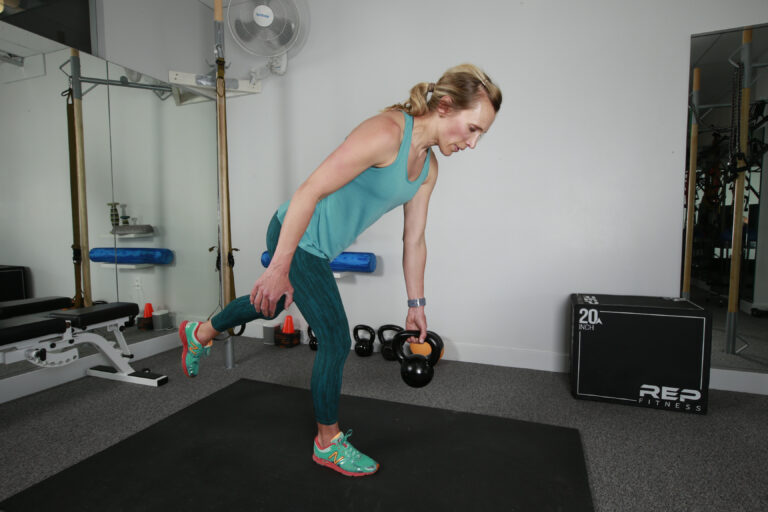
Deep squats, split squats, deadlifts, and Olympic lifting all require different combinations of hip motion.
A hip mobilization can be paired directly with the movement you’re preparing for. For example, mobilization followed by a controlled squat or split squat works well.
For Field and Court Athletes
Cutting, shuffling, decelerating, and changing direction require the hip to move through multiple planes.
The Research Behind Hip Mobilization
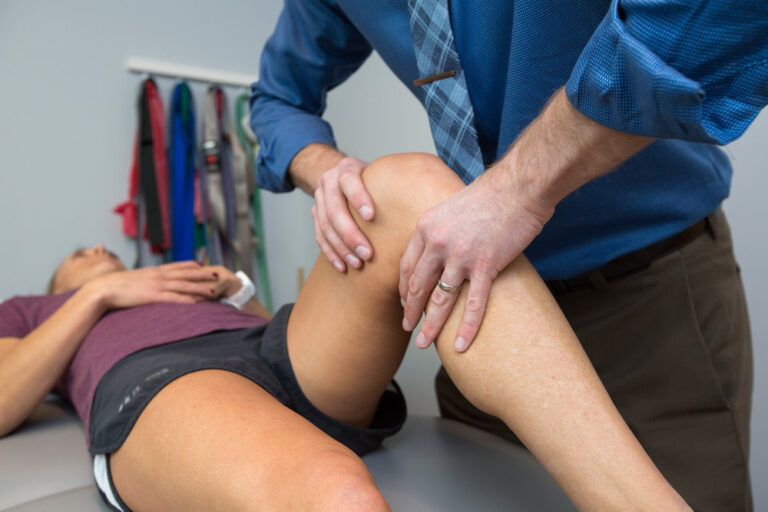
While research specifically on banded self-mobilizations is limited, there is evidence supporting the broader concept of applied hip mobilization and mobilization-with-movement as techniques for improving hip range of motion and function.
A systematic review and meta-analysis found improvements in range of motion following mobilization-with-movement techniques, including improvements of approximately 4.5°–14.8° in studies involving the hip. Another review found moderate evidence that hip mobilizations can improve hip range of motion and patient function.
While these studies don’t specifically test banded self-mobilizations, we use this approach as a practical, at-home version of mobilization-with-movement, allowing patients to apply a gentle external force while actively moving through the hip’s available range.
More Mobility Isn’t Always Better
This is an important distinction.
The goal isn’t to chase more mobility just for the sake of it. Instead, we want to use mobility work to help you access the positions and movements that matter to you, whether that’s running, climbing, lifting, or simply moving through everyday life.
The research examining hip motion across different activities supports this individualized approach. Some activities require relatively modest hip motion, while others require combinations of motion that go well beyond what we might consider typical daily movement.
So rather than asking:
“How much hip mobility do I have?”
We might ask:
“How much hip mobility do I need for what I want to do?”
That’s a much more useful question.
Try This Approach
If you’re using a banded hip mobilization, think: Mobilize → Move → Load → Perform
Use the band to explore a range that feels restricted, then immediately follow up by practicing the functional movement pattern that matters to you.
For a runner, that might mean a few strides.
For a climber, it might mean practicing a high step or drop-knee position.
For a lifter, it might mean getting into a squat or split squat.
For an athlete, it might mean progressing toward a change-of-direction drill.
That’s where mobility becomes more than just stretching — it becomes movement preparation.
At Mend, our goal isn’t simply to help you move more. It’s to help you move better for the things you actually want to do. If a hip restriction is showing up in your squat depth, your stride, or your reach into a high step, a hands-on assessment can tell you exactly what’s limiting you. Book a hip mobility assessment with the team at Mend Colorado.
References
Han S, Kim RS, Harris JD, Noble PC. The envelope of active hip motion in different sporting, recreational, and daily-living activities: A systematic review. Gait & Posture. 2019;71:227-233. doi:10.1016/j.gaitpost.2019.05.006.
Stathopoulos N, Dimitriadis Z, Koumantakis GA. Effectiveness of Mulligan’s Mobilization With Movement Techniques on Range of Motion in Peripheral Joint Pathologies: A Systematic Review With Meta-analysis Between 2008 and 2018. Journal of Manipulative & Physiological Therapeutics. 2019;42(6):439-449. doi:10.1016/j.jmpt.2019.04.001.
Albertin ES, Miley EN, May J, Baker RT, Reordan D. The Effects of Hip Mobilizations on Patient Outcomes: A Critically Appraised Topic. Journal of Sport Rehabilitation. 2019;28(4):390-394. doi:10.1123/jsr.2016-0238.