Achilles tendon pain, previously called Achilles tendinitis and now called Achilles tendinopathy, affects sedentary, active, and athletic people. The 2024 clinical practice guideline from the Academy of Orthopaedic Physical Therapy puts the overall prevalence of midportion Achilles tendinopathy at 4% to 7% and reports a lifetime cumulative incidence of Achilles tendon injury of 40% to 52% in runners (Chimenti et al., JOSPT, 2024).
If your Achilles hurts and you want to know what helps, the short answer is progressive loading of the tendon, matched to your pain, with a plan to get you back to the activity you care about. This article covers what the guideline recommends and where each treatment fits in our practice.
What causes Achilles tendinopathy
In our practice we most commonly see this injury in patients with a training error, either too much too soon or too little for too long, in activity frequency, duration, or intensity. Abnormal mechanics from imbalances of strength, mobility, and balance can also play a role. We cover the contributing factors in more detail in risk factors for Achilles tendinopathy.
Symptoms and how it is diagnosed
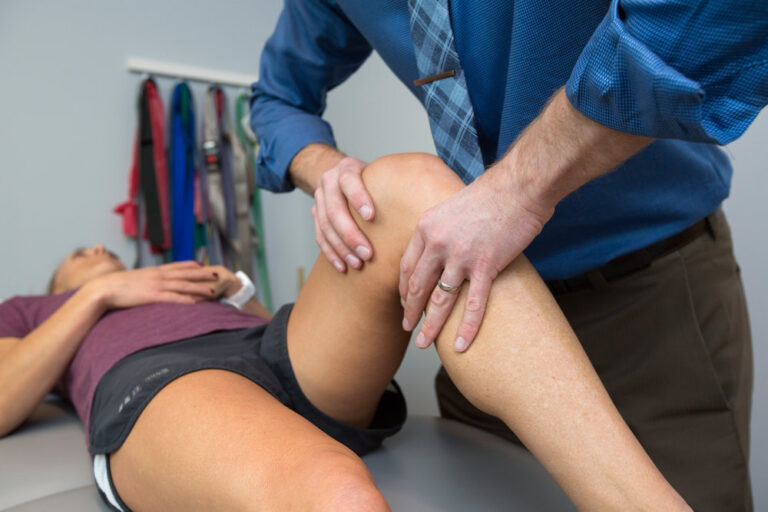
Patients report pain, stiffness, and loss of function with daily and recreational activities. In midportion tendinopathy the pain sits roughly 2 to 6 cm above the heel. In a study comparing 10 clinical tests against ultrasound, pain in that location and tenderness when the tendon is pressed were the only two reliable and accurate enough to recommend (Hutchinson et al., 2013). A physical therapy exam also identifies the training and mechanical factors that overloaded the tendon in the first place. For how imaging fits in, see how important imaging is for tendon pain.
A sudden pop with immediate weakness is a different problem and needs prompt medical evaluation. Calf weakness can also linger for years after a rupture is repaired (calf muscle weakness after Achilles tendon repair).
Exercise is the first-line treatment
As our understanding of tendon injuries has improved, we have moved away from strict rest and toward load management. That means balancing activity, exercise for the injured tendon, and recovery time, which is often a challenging task. As the tendon is loaded through exercise it goes through remodeling, an important part of healing. The tendon improves its stiffness, strength, and tolerance for the activities you want to do. In one follow-up of 26 tendons treated with a 12-week eccentric program, tendon thickness had decreased and structure had returned to normal in 19 of them at an average of 3.8 years (Öhberg et al., 2004).
The 2024 guideline gives tendon loading a grade A recommendation as first-line treatment, using loads as high as the patient can tolerate, at least three times a week. Evidence supports both eccentric exercise and heavy-load programs that combine concentric and eccentric work. The original eccentric protocol came from Alfredson and colleagues, who put recreational athletes with chronic Achilles tendinopathy through 12 weeks of heavy-load eccentric calf training. All 15 in the training group returned to full running, while all 15 who received conventional care went on to surgery (Alfredson et al., 1998). It was a small study. Later systematic reviews found that other loading programs, including combined concentric and eccentric loading, produce similar results for pain and function (Malliaras et al., 2013; Habets and van Cingel, 2015). You also do not need to hit the original protocol’s 180 repetitions a day: in a small trial, a do-as-tolerated volume did as well over 6 weeks (Stevens and Tan, 2014).
For the exercises themselves, see why eccentric exercise helps Achilles tendinopathy. For how much weight to use and how to progress it, see how much weight to use and how heavy to load your Achilles after an overuse injury.
Complete rest slows healing
The guideline states that complete rest is not indicated and recommends continuing activity within pain tolerance (grade B). A tendon has limited blood supply and metabolism compared with other tissues, so it needs exercise to heal. We use a progressive, Goldilocks approach: doing too little is as harmful as doing too much. As the tendon becomes resilient to a given level of activity, we raise the load and volume slowly until you are back to 100%.
How long Achilles tendinopathy takes to heal
An injured tendon can take up to a year to heal completely at the tissue level. Symptoms usually resolve around 12 to 16 weeks, and we advise patients to keep exercising after that to protect against recurrence. Our article on preventing recurrence and returning to sport covers that phase.
Stretching, manual therapy, and dry needling
Limited ankle dorsiflexion is a common risk factor in patients with Achilles tendinopathy. The guideline allows stretching of the calf muscles when dorsiflexion is limited (grade C), but the supporting evidence is weak. We usually prescribe strength training within the ankle’s available range instead of static stretching, and recent evidence suggests eccentric strengthening improves mobility about as well as static stretching.
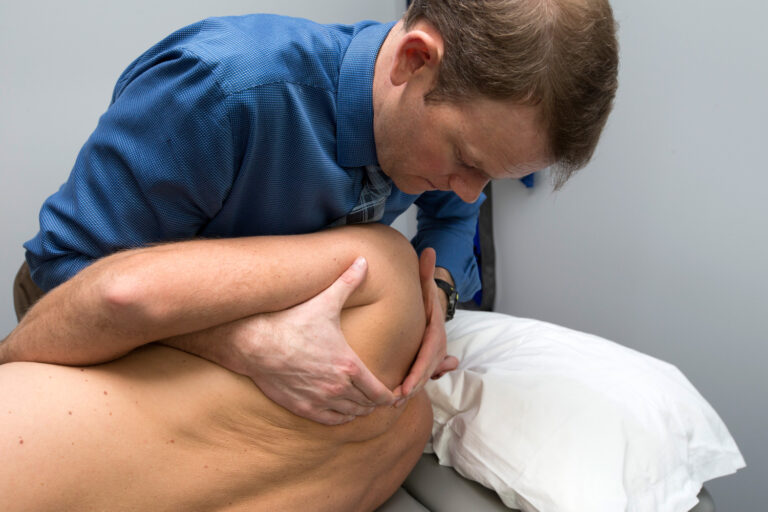
Manual therapy and dry needling carry the lowest grades in the guideline (grade F, expert opinion). In our Boulder practice we find joint manipulation, mobilization, and dry needling effective in the short term for reducing pain and improving function. We withdraw these passive treatments as soon as patients begin loading the tendon. You can read more about our manual therapy approach.
Ultrasound and laser
The guideline recommends against low-level laser for midportion Achilles tendinopathy and against therapeutic ultrasound as a stand-alone treatment (both grade C).
Heel lifts and orthotics
The guideline says heel lifts may be used to temporarily reduce ankle dorsiflexion during activity (grade C), and it makes no recommendation on orthotics because the evidence is contradictory (grade D). In our practice we generally do not recommend inserts, because of their short-term, limited effectiveness and the potential for long-term problems including joint tightness and muscle weakness.
When to see a physical therapist
A physical therapist can correct your mechanics, identify what is overloading the tendon, and set the load management plan, including how to stay active while you recover. If Achilles pain is limiting your activity, book an Achilles evaluation with one of our physical therapists.
Frequently asked questions
Progressive tendon loading is the best-supported treatment. The 2024 guideline gives it a grade A recommendation as first-line care, at the highest load you can tolerate, at least three times a week.
No. Complete rest is not indicated. The guideline recommends staying active within your pain tolerance, because the tendon needs load to remodel.
Symptoms usually settle in 12 to 16 weeks with a loading program. Full healing at the tissue level can take up to a year, so we recommend continuing exercise after symptoms resolve.
Yes. Evidence supports eccentric exercise and heavy-load programs that combine concentric and eccentric work. See our eccentric exercise article for details.
Heel lifts may temporarily reduce stress on the tendon during activity (grade C). The guideline makes no recommendation on orthotics because the evidence conflicts.
More on this topic: Achilles Pain and Tendinopathy articles.
References
- Chimenti RL, Neville C, Houck J, Cuddeford T, Carreira D, Martin RL. Achilles pain, stiffness, and muscle power deficits: midportion Achilles tendinopathy revision, 2024. J Orthop Sports Phys Ther. 2024;54(12):CPG1-CPG32. doi:10.2519/jospt.2024.0302
- Alfredson H, Pietila T, Jonsson P, Lorentzon R. Heavy-load eccentric calf muscle training for the treatment of chronic Achilles tendinosis. Am J Sports Med. 1998;26(3):360-366. PMID 9617396
- Hutchinson AM, et al. What is the best clinical test for Achilles tendinopathy? Foot Ankle Surg. 2013;19(2):112-117. PubMed
- Öhberg L, Lorentzon R, Alfredson H. Eccentric training in patients with chronic Achilles tendinosis: normalised tendon structure and decreased thickness at follow up. Br J Sports Med. 2004;38(1):8-11. PubMed
- Malliaras P, et al. Achilles and patellar tendinopathy loading programmes: a systematic review comparing clinical outcomes and identifying potential mechanisms for effectiveness. Sports Med. 2013;43(4):267-286. PubMed
- Habets B, van Cingel RE. Eccentric exercise training in chronic mid-portion Achilles tendinopathy: a systematic review on different protocols. Scand J Med Sci Sports. 2015;25(1):3-15. doi:10.1111/sms.12208
- Stevens M, Tan CW. Effectiveness of the Alfredson protocol compared with a lower repetition-volume protocol for midportion Achilles tendinopathy: a randomized controlled trial. J Orthop Sports Phys Ther. 2014;44(2):59-67. PubMed
- Bohm S, et al. Human Achilles tendon plasticity in response to cyclic strain: effect of rate and duration. J Exp Biol. 2014;217(22):4010-4017. doi:10.1242/jeb.112268