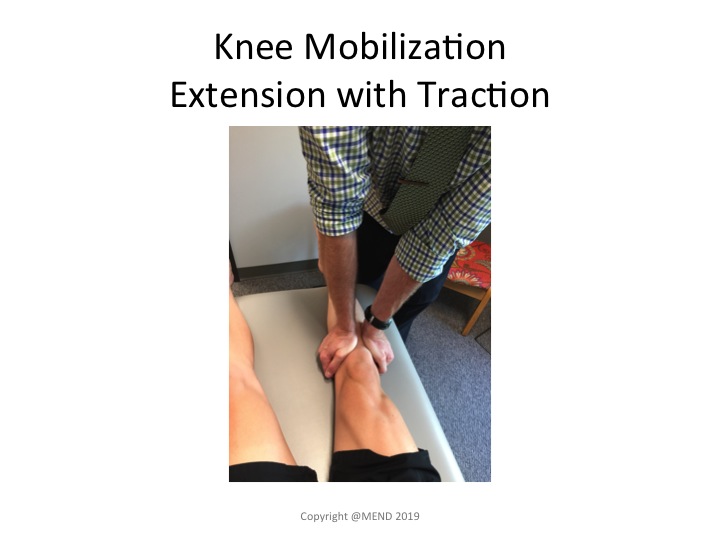
If your knee will not fully straighten after ACL reconstruction, those last few degrees deserve attention early. Lost extension changes how you walk, keeps your quadriceps working in a bent position, and gets harder to recover the longer it sits. Knee mobilization is one of the hands-on tools physical therapists use to help, though the research on it is thinner than the clinical reasoning behind it.
Why the last few degrees of extension matter
Full extension means your knee straightens as far as your other knee does, including any natural hyperextension. When it stops short, the joint sits slightly bent during standing and walking. The quadriceps works harder to hold you up, and the joint surfaces load differently with every step.
The long-term signal comes from a 2012 cohort study in the American Journal of Sports Medicine by Shelbourne and colleagues, who followed 780 patients for an average of 10.5 years after ACL reconstruction. Among patients with normal extension and flexion at both early and final follow-up, 39% had arthritis on X-ray. Among those with less than normal motion at both time points, 53% did, and the odds of arthritis were about twice as high in patients with abnormal motion at final follow-up. This was a single-center cohort, so it shows an association rather than proof that restoring motion prevents arthritis. It is still why we treat extension as an early priority.
Why extension stalls after ACL surgery
Three things usually keep the knee bent.
Swelling and pain come first. Swelling changes the signals coming from sensory receptors inside the joint, and the nervous system responds by turning down quadriceps activation, a process called arthrogenic muscle inhibition. Rice and McNair described the mechanism in a 2010 review in Seminars in Arthritis and Rheumatism, naming swelling, inflammation, and joint damage as drivers. A quadriceps that cannot fire cannot pull the knee straight, and the hamstrings tend to guard in response.
Tissue mobility comes second. The kneecap has to glide upward for the knee to straighten, and scar tissue or a stiff fat pad behind the patellar tendon can restrict that glide, particularly after a patellar tendon graft.
The third cause is mechanical, and it is uncommon. Something physically blocks the last degrees of motion, such as a scar nodule in front of the graft (a cyclops lesion). Hands-on work does not fix a block, which is why we screen for one before treating stiffness.
What knee extension mobilization looks like in the clinic
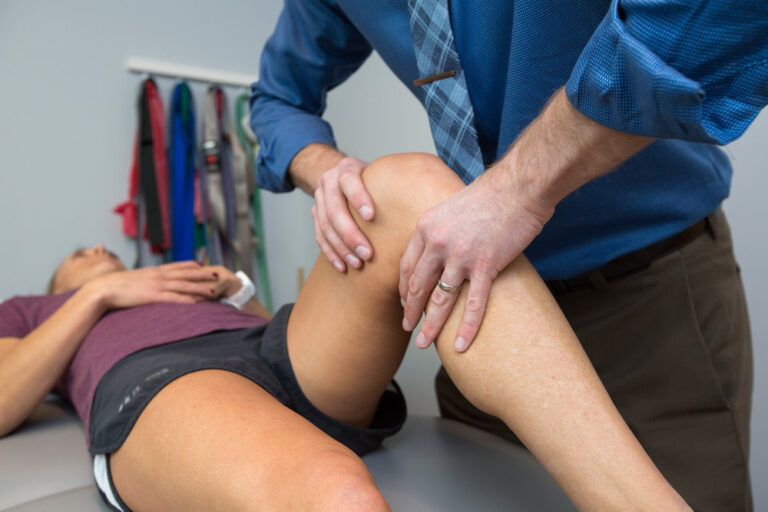
Knee mobilization is skilled, hands-on movement of the joint by a physical therapist. After ACL surgery it usually involves two techniques, and the direction, depth, and timing of both depend on your graft type, your surgeon’s protocol, and how irritable the knee is. We avoid positions that load the graft.
Patellar mobilization
The therapist glides the kneecap up, down, and side to side to restore the movement the knee needs to straighten and bend. This is usually the first technique we use because it is gentle and directly targets the kneecap’s role in extension.
Tibiofemoral mobilization
The therapist guides the shinbone and thighbone through small, controlled movements to reduce joint stiffness and pain. In the first weeks, the graft sets the limits on which positions are appropriate.
Mobilization makes room for the work that actually restores extension: heel props, prone hangs, and quadriceps activation in the last degrees of motion. It reduces pain and stiffness enough for those exercises to be done well. It does not replace them. If you want the general version of this technique, our guide to knee mobilization covers it, and the Manual Therapy library shows how we use it at other joints.
What the evidence shows
The strongest evidence is for early movement after surgery. The 2017 clinical practice guideline on knee ligament sprain from the APTA Orthopaedic Section, published in JOSPT, recommends immediate mobilization within one week of ACL reconstruction to increase range of motion and reduce pain, with an A grade for strength of evidence. In that guideline, mobilization means getting the knee moving early, not a manual joint technique. It also recommends neuromuscular electrical stimulation for 6 to 8 weeks after surgery to build quadriceps strength, which we cover in our article on dry needling and NMES for quadriceps strength after ACL surgery.
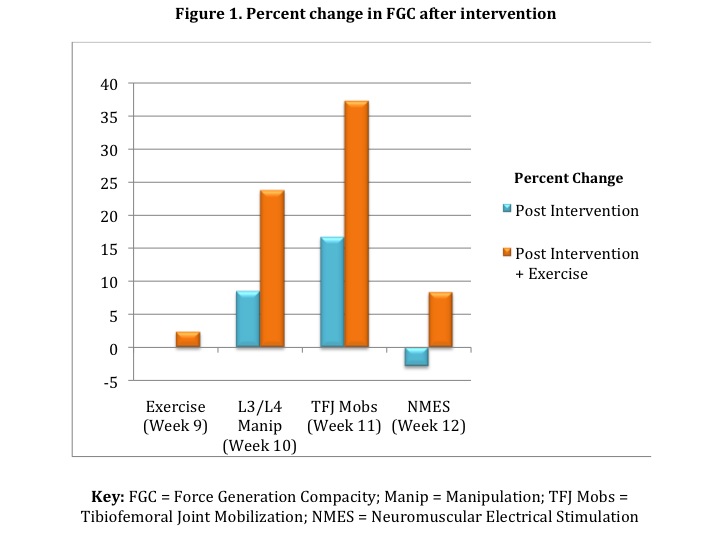
Evidence for hands-on joint mobilization specifically is thin. Ruggirello and colleagues presented a case report at the 2017 AAOMPT conference describing one patient after ACL reconstruction, in whom tibiofemoral manual therapy produced a larger gain in quadriceps force than lumbar manipulation or electrical stimulation. One patient cannot tell us whether that holds for anyone else. It does fit the mechanism above: if pain and swelling are turning the quadriceps down, treating the joint may help turn it back up.
When stiffness becomes fixed, the options escalate. A 2024 systematic review found that manipulation under anesthesia and lysis of adhesions were the most commonly reported treatments for arthrofibrosis after knee arthroscopy or ACL reconstruction. Early extension work exists to avoid that outcome. Our ACL Recovery articles cover the rest of the rehab timeline.
When to get help
Tell your surgeon and your PT if your knee cannot reach the same extension as the other side after the first couple of weeks, if it feels blocked or bounces at the end of straightening, or if swelling keeps climbing instead of settling. Call your surgeon’s office promptly for a hot, red, or increasingly swollen knee, a fever, or calf pain and swelling, because those point to infection or a blood clot rather than stiffness.
Our guides on why pre-operative therapy matters before ACL surgery and when you can start jumping after ACL surgery show how extension fits into the rest of the timeline.
Frequently asked questions
It is hands-on work by a physical therapist aimed at helping the knee straighten fully. After ACL surgery it typically combines patellar glides and gentle tibiofemoral mobilization with heel props, prone hangs, and quadriceps activation. It supports the exercises rather than replacing them.
Start with swelling control and daily low-load positioning such as heel props, then add quadriceps activation at the end of the range. If the knee still stops short of the other side after the first couple of weeks, ask your PT to assess kneecap mobility and hamstring guarding. A persistent loss or a blocked feeling needs your surgeon.
It is when a physical therapist who knows your graft and your surgeon’s protocol performs it. Techniques are chosen to avoid loading the graft, and a sharp catch or increasing pain means stop and reassess. Do not try forceful stretching or self-manipulation on a stiff knee.
Early movement begins within the first week under most protocols. Hands-on joint mobilization depends on your surgeon’s restrictions and the state of the knee, and your PT confirms what is appropriate at each visit.
The evidence is limited to a single-patient case report from AAOMPT 2017, where tibiofemoral mobilization produced a larger quadriceps force gain than lumbar manipulation or electrical stimulation. That is not enough to promise the same result for you. Neuromuscular electrical stimulation and progressive strengthening have stronger support.
If you are several weeks past ACL surgery and your knee still will not straighten as far as the other one, book an assessment at mendcolorado.com. We measure extension against your other knee, check kneecap mobility and quadriceps activation, and coordinate with your surgeon on what is safe. Our ACL rehab team in Boulder County sees this pattern often.