
If you’ve ever finished a mountain bike ride and thought, “Why am I numb down there?” you’re not alone.
Mountain bike saddle numbness, genital tingling, pressure, vulvar discomfort, and pelvic pain are all symptoms reported by female cyclists, yet they aren’t topics that come up very often at the trailhead. Some saddle discomfort may feel like an unavoidable part of riding, but persistent or recurrent numbness is worth paying attention to rather than simply riding through it.
As a physical therapist who treats pelvic floor disorders, and a mountain biker myself, I think this is an important conversation for female riders, especially here in Boulder, where a great day on the bike can mean hours of climbing, technical descending, and plenty of time in the saddle.
What Causes Mountain Bike Saddle Numbness?
When you ride, your saddle supports a meaningful amount of your body weight. Your riding position, saddle shape and width, bike setup, terrain, and time in the saddle can all affect how that pressure is distributed.
Research in female cyclists has found associations between cycling, saddle pressure, and changes in genital sensation, pain, and numbness. One likely contributor is pressure on soft tissues and sensory nerves in the perineal region, the area between the vulva and anus.
Mountain bike saddle numbness isn’t necessarily just a “pelvic floor problem.” For some riders, saddle shape or bike position may be the main issue. For others, muscle tension, movement patterns, tissue sensitivity, or training load may be more relevant.
What Does the Research Say?
Most research on cycling-related pelvic symptoms has focused on road or recreational cyclists rather than female mountain bikers specifically. A 2023 narrative review of road and off-road cycling research found that saddle pressure is influenced by riding time and intensity, trunk and hand position, handlebar position, saddle design, and saddle height (Vicari et al., 2023). The review also identified the repeated jolts and impacts of mountain biking as a possible contributor to perineal and urogenital symptoms.
A few findings stand out for female riders. In competitive cyclists, traditional saddles were associated with lower average perineal pressure than cut-out saddles (Guess et al., 2011). That doesn’t mean cut-out saddles are bad; it means they aren’t automatically better for every rider. Saddle width matters too (Lin et al., 2023), and current research doesn’t point to one saddle shape that works best for everyone.
Riding position matters as well. Handlebars positioned below saddle height were associated with higher perineal pressure and decreased genital sensation compared with higher handlebar positions (Partin et al., 2012). That doesn’t mean every rider needs higher handlebars, but a more forward, lower position may increase pressure toward the perineum for some riders.
Numbness itself is worth paying attention to. Genital numbness and pain have been associated with higher odds of sexual dysfunction in female cyclists (Greenberg et al., 2019; Lui et al., 2021). Those studies show an association, not proof that cycling-related numbness directly causes sexual dysfunction. But if you regularly experience numbness, especially if it begins early in a ride, lasts after your ride, or occurs with pain, it’s worth addressing.
Why Might Mountain Biking Be Different?
Mountain biking isn’t the same as sitting on a road bike for several hours. On the trail, you’re constantly changing position: standing to climb, shifting your hips back on descents, moving forward for technical climbs, absorbing repeated impacts, bracing through the trunk and hips, and moving around on the saddle. All of this may change how pressure is distributed throughout a ride, and the added terrain jolts may affect the perineal region differently than steady road riding (Vicari et al., 2023).
We still need more research specifically involving female mountain bikers. Most of what we know comes from other cycling populations, so the research is a starting point, not a one-size-fits-all answer.
What Can You Do About It?
Start with your bike setup. Saddle width, shape, height, tilt, fore-aft position, handlebar position, and overall riding posture all influence pressure distribution. If you’re consistently experiencing numbness or discomfort, a professional bike fit is a good place to start. Don’t assume the most expensive or most heavily padded saddle is automatically the right choice. More cushioning isn’t always more comfortable if it changes where pressure is concentrated.
Pay attention to when symptoms start. Ask yourself: is it 20 minutes into the ride? After a long climb? During sustained seated pedaling? Only on one bike or certain terrain? If numbness consistently appears early in a ride, don’t assume you simply need to “build tolerance.” It’s worth looking more closely at your setup, riding habits, and training load.
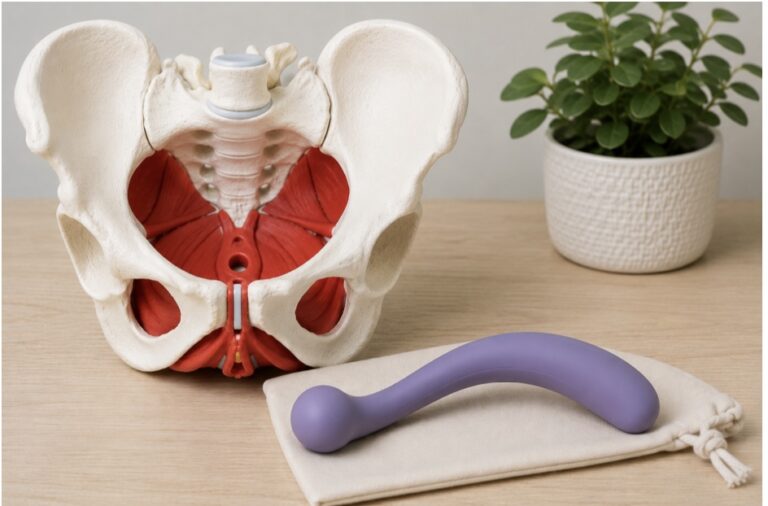
Don’t automatically assume you need more Kegels. When people hear “pelvic floor,” they often think: strengthen, strengthen, strengthen. But the pelvic floor also needs to relax, coordinate with breathing and the abdominal muscles, and respond to changes in pressure. For some riders, weakness is part of the picture. For others, muscle tension, poor coordination, or something unrelated to strength is more relevant. More Kegels aren’t automatically the answer.
Look at the bigger picture. As a PT, I’m interested in more than what happens at the saddle: your riding position, symptoms, training volume, recent changes in riding, hip and trunk movement, mobility, breathing and pressure management, and pelvic floor function when appropriate. Sometimes the answer is primarily a bike setup issue. Sometimes it’s related to how you’re loading your body on the bike. The goal isn’t to find one “perfect” saddle; it’s to identify what may be contributing to your symptoms and find a practical path forward.
The Bottom Line
Saddle numbness, tingling, pressure, and pelvic discomfort are reported by many female cyclists, but that doesn’t mean you should accept them as part of riding. The solution may involve adjusting your bike setup, changing riding position, managing training load, trying a different saddle, addressing pelvic floor function, or combining several of these approaches. Research doesn’t support one universal solution for all female riders, especially mountain bikers.
If you are experiencing recurrent mountain bike saddle numbness, pelvic or vulvar pain, urinary symptoms, or symptoms that persist after riding, it is worth being evaluated by a pelvic floor physical therapist. Schedule an appointment to get started.
FAQ
Occasional mild numbness on a long ride is common and not automatically a red flag. Numbness that shows up early in a ride, lasts well after you’re off the bike, or comes with pain or urinary symptoms is worth having evaluated by a pelvic floor physical therapist.
Not necessarily. More padding can shift where pressure concentrates rather than reducing it. A professional bike fit that looks at saddle width, height, tilt, and handlebar position is a better starting point than upgrading to the priciest option.
Not automatically. The pelvic floor needs to relax and coordinate, not just contract. For some riders strength is part of the picture, but for others tension, coordination, or bike setup matter more. A pelvic floor evaluation can tell you which applies to you.
References
- Guess MK, Partin SN, Schrader S, Lowe B, LaCombe J, Reutman S, Wang A, Toennis C, Melman A, Mikhail M, Connell KA. Women’s bike seats: A pressing matter for competitive female cyclists. Journal of Sexual Medicine. 2011;8(11):3144-3153. https://pubmed.ncbi.nlm.nih.gov/21834869/
- Partin SN, Connell KA, Schrader S, LaCombe J, Lowe B, Sweeney A, Reutman S, Wang A, Toennis C, Melman A, Mikhail M, Guess MK. The bar sinister: Does handlebar level damage the pelvic floor in female cyclists? Journal of Sexual Medicine. 2012;9(5):1367-1373. https://pmc.ncbi.nlm.nih.gov/articles/PMC3780597/
- Greenberg DR, Khandwala YS, Breyer BN, Minkow R, Eisenberg ML. Genital pain and numbness and female sexual dysfunction in adult bicyclists. Journal of Sexual Medicine. 2019;16(9):1381-1389. https://doi.org/10.1016/j.jsxm.2019.06.017
- Trofaier ML, Schneidinger C, Marschalek J, Hanzal E, Umek W. Pelvic floor symptoms in female cyclists and possible remedies: A narrative review. International Urogynecology Journal. 2016;27(4):513-519.
- Lui H, Mmonu N, Awad M, et al. Association of bicycle-related genital numbness and female sexual dysfunction: Results from a large, multinational, cross-sectional study. Sexual Medicine. 2021;9(3):100365. https://doi.org/10.1016/j.esxm.2021.100365
- Vicari DSS, Patti A, Giustino V, Figlioli F, Alamia G, Palma A, Bianco A. Saddle pressures factors in road and off-road cyclists of both genders: A narrative review. Journal of Functional Morphology and Kinesiology. 2023;8(2):71. https://pmc.ncbi.nlm.nih.gov/articles/PMC10299674/
- Lin ZJ, Wang HH, Chen CH. The effect of bicycle saddle widths on saddle pressure in female cyclists. Journal of Sports Science & Medicine. 2023;22(3):425-430. https://pmc.ncbi.nlm.nih.gov/articles/PMC10499128/