Blog

Evidence demonstrates equal long term outcomes between Physical Therapy and surgery for non traumatic rotator cuff tears.  Patient’s most appropriate for surgical repair include patients with larger tears, greater disability and limitations with arm use, and those with a low expectation for recovery with conservative care.  Among those patients opting for surgical interventions up to...

We have previously written about the move away from arthroscopic surgery for degenerative meniscal tears and knee arthritis based on surgery’s limited effectiveness in the medical research.  In addition, these surgeries have not been able to show greater outcomes than placebo or sham surgery.  Until recently, studies have not utilized a comparable placebo group to...

Previous research has found no significant difference at either 1 or 2 year follow up between Physical Therapy or surgery for rotator cuff tears.  One disproven argument you may still hear against the conservative care of these tears is they may worsen over time including larger tear sizes or further movement of the torn ends...

Posture has a controversial and complex role in musculoskeletal pain.  Some research studies have found zero to weak correlations between posture and pain while other studies have shown it can both impact pain and function.  One area of the body where posture may have a larger role is with shoulder function.  Individuals with limited mid...

MRI testing of the shoulder is no different than testing in other body regions.  Pathologies such as bursa changes, tendinopathies, labral and rotator cuff tears are very common in asymptomatic populations and tend to increase with an individual’s age.  Many of these MRI findings do not contribute to a patient’s current symptoms and may be...

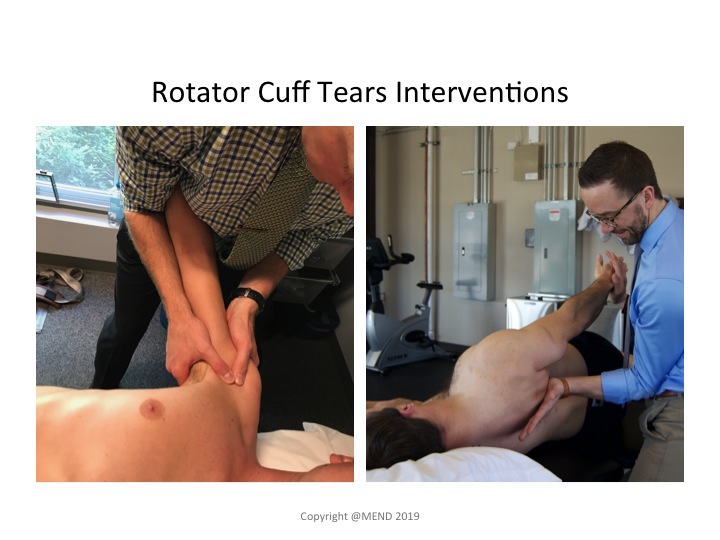
Previous research has documented no difference in long term outcomes between Physical Therapy and surgery for patients with rotator cuff tears.  Many patients with rotator cuff tears, including massive tears, do well with conservative treatment of their shoulder injuries demonstrating improvements in pain, strength, and function.  Strength training makes up the foundation of conservative care...

Shoulder pain remains one of the top 3 reasons patients seek care from their primary care physician and Physical Therapist. The most common diagnosis causing pain among these patients is subacromial impingement syndrome. Impingement can be found along with rotator cuff tendon pain (tendinopathy) or partial rotator cuff tears on clinical exam and imaging. Impingement...

photo credit: radiopaedia.org Magnetic resonance imaging of musculoskeletal pain has long been known to find various pathologies, including herniated disks, tendon tears, and spinal stenosis, which may or may not contribute to an individual’s symptoms.  These spinal and extremity findings are common in pain free individuals especially over the age of 30 years old.  As...

Imaging technologies, including MRI, continue to improve providing valuable insight into the human body. These advancements have made MRI scans extremely sensitive to identifying tissue pathology and the presence of disease within the body. In the musculoskeletal system, the MRI’s sensitivity reduces its’ ability to specifically detect symptomatic vs. asymptomatic pathology. For example, after age...