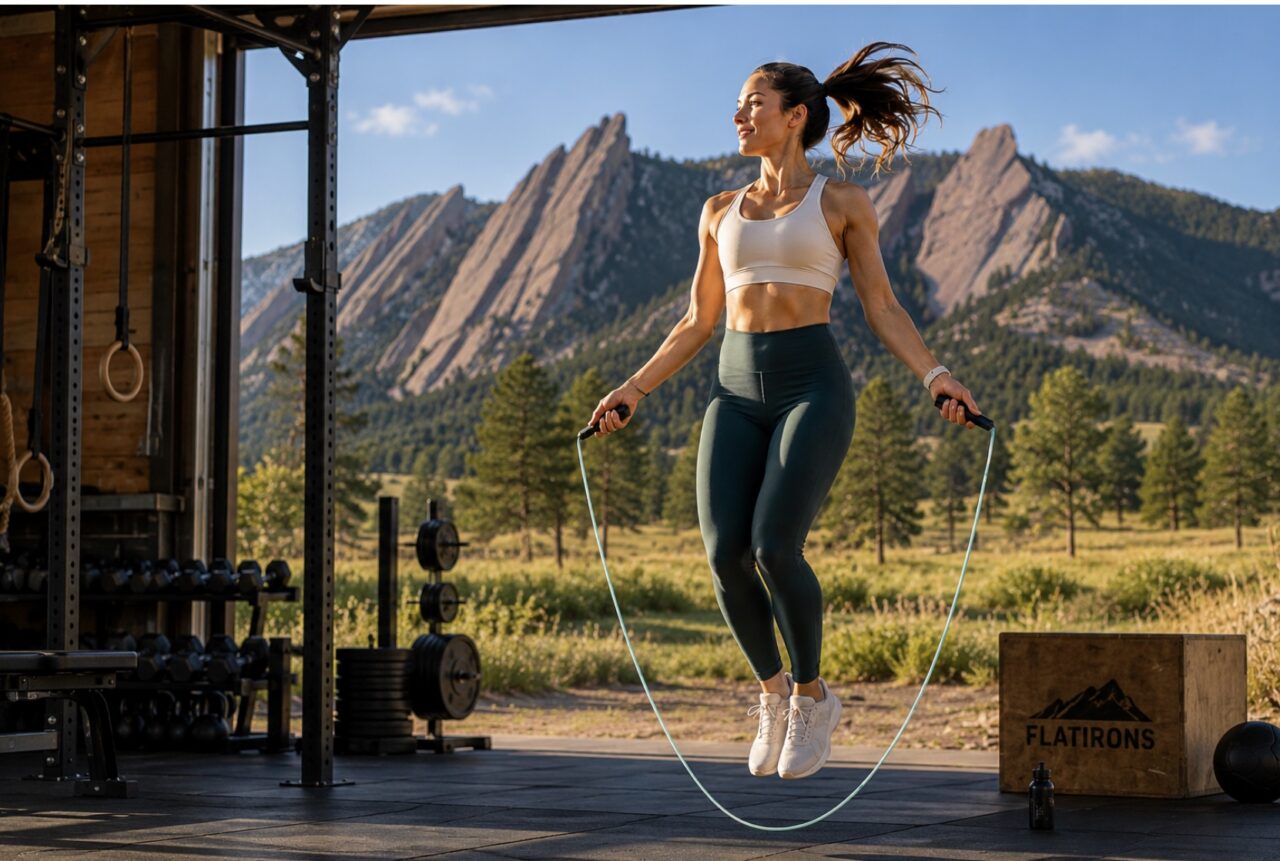
Let’s talk about something most women quietly deal with but rarely bring up: leaking when you jump rope. If you’ve ever felt that unexpected drip mid workout, or quietly avoided jump rope altogether, you’re not alone, and it is not just “part of being a woman.” As your physical therapist (PT) and coach, I want to give you the tools to jump with confidence.
This guide covers jump rope mechanics, a warm-up checklist to prep your pelvic floor, and two simple cues (breathing and staying loose) that can dramatically reduce urgency and leaking during impact exercise.
Why You Leak When You Jump Rope (and How to Stop It)
Stress urinary incontinence (SUI) refers to leaking with impact, exertion, or sudden movement. It is common, but it is not normal. It’s a signal that your pelvic floor is either not generating enough force, not timing its contractions correctly, or is too tight to respond at all. The good news? Both jump rope mechanics and how you breathe play a direct role in how much load your pelvic floor has to manage.
Part 1: Choosing the Right Jump Rope
Your equipment matters more than you’d think. An efficient rope reduces the effort per jump, which means less impact, less breath-holding, and a happier pelvic floor.
What to look for:
- Speed rope (thin cable, ball bearings): Turns with minimal effort. Less arm fatigue means better rhythm and more consistent breathing. Great for beginners and experienced jumpers alike. Brands like Rx Smart Gear, Buddy Lee, or WOD Nation are solid choices.
- Correct rope length: Stand on the center of the rope; handles should reach your armpits. Too long leads to sloppy turnover and more compensations. Too short creates a choppy rhythm and encourages breath-holding.
- Handles with grip: Sweaty hands cause overgripping, which tightens your whole upper body and yes, your pelvic floor too. A good grip matters.
- Surface: Jump on a forgiving surface when possible (rubber mat, gym flooring). Hard concrete increases ground reaction force and pelvic floor demand.Tip: Avoid thick, heavy “fitness ropes” for conditioning work.
The extra effort to turn the rope encourages breath-holding and full-body bracing, both of which are hard on your pelvic floor.
Part 2: Pre-Jump Rope Warm-Up Checklist
Before you pick up the rope, spend 5 to 7 minutes on this checklist. This sequence wakes up your pelvic floor, loads your single-leg stability, and trains the timing your body needs.
Work through these in order:
20 Single-Leg (SL) Heel Raises (each side)
Stand on one foot, rise slowly to the ball of your foot, lower with control. This fires your calf, your primary shock absorber during jumping, and challenges single-leg stability at the ankle and hip. Use a wall lightly for balance if needed.
10 SL Deadlifts (each side) bodyweight or light KB
Hinge at the hip, keep a long spine. These activate your glutes and hamstrings, which support the pelvis from the back.
20 Banded or Bodyweight Squats, focus on exhale on the way up
Practice exhaling through the effort. This is your pelvic floor breath prep (more on this below).
10 Lateral Band Walks (each direction)
Hip abductor activation stabilizes your pelvis during the single-leg loading phase of each jump.
10 Pelvic Floor “Quick Flicks”
Rapid, light contractions of your pelvic floor (not a max squeeze; think tapping a finger quickly rather than making a fist). This primes the fast-twitch response your pelvic floor needs for impact.
5 Slow, Full Breaths with 360° rib expansion
Breathe in through your nose, feel your ribs expand outward in all directions, let your belly soften. This resets your diaphragm-pelvic floor relationship before you start jumping.
Part 3: Jump Rope Mechanics: Jump Smarter, Not Harder
Most leaking during jump rope isn’t from jumping too hard. It’s from jumping wrong. Here’s what efficient jumping looks like:
Land softly, not flat. Land on the balls of your feet first, then let your heel kiss the ground. A full flat-foot landing sends a shockwave up through your pelvis. Soft landings mean more absorption at the ankle and knee and less demand on the pelvic floor.
Stay low. You only need about 1 inch of clearance off the ground. High jumps mean harder landings. Think “skim the surface,” not “leap.”
Knees slightly bent at all times but don’t rely on these to generate power up. Don’t land too locked out. Soft knees act as natural shock absorbers.
Elbows close, wrists doing the work. Your arms shouldn’t be flying out wide. Keep elbows near your ribs, and let your wrists turn the rope in small, relaxed circles. Less upper body tension means less whole-body bracing and less inadvertent pelvic floor gripping.
Eyes forward, chin neutral. Looking down shifts your weight forward and changes your center of mass. Keep your gaze at eye level.
Find a rhythm before you find speed. Consistent, relaxed rhythm is everything. An unpredictable tempo leads to breath-holding and anticipatory bracing, both of which spike intra-abdominal pressure on your pelvic floor.
Part 4: Two Cues That Actually Work: Breathing and Staying Loose
This is where your PT knowledge meets your coaching experience. These two cues directly address the mechanism of exercise-induced leaking.
Cue #1: Exhale on Impact
When you hold your breath during jumping, especially at the moment of landing, intra- abdominal pressure spikes sharply. That pressure has to go somewhere, and if your pelvic floor isn’t ready, it goes down and out.
The fix: Develop a light, rhythmic exhale pattern while you jump. You don’t need to forcefully blow air out. A gentle, audible “huh… huh… huh” with each landing is enough. Some women find it helpful to hum or even count out loud.
This works because a coordinated exhale engages your deep core (transverse abdominis) and naturally times your pelvic floor contraction to meet the impact, without you having to think about a conscious kegel.
Practice drill: Jump slowly (every other beat if needed) and exhale one puff of air with each landing. Build up to your normal rhythm once the breath pattern feels automatic.
Cue #2: Stay Loose, Especially If You Feel an Urge
Here’s the counterintuitive one: when you feel an urge to leak, your instinct is to grip; brace your abs, clench everything, stop moving. That clenching actually increases the pressure on the bladder and can trigger the leak you’re trying to prevent.
The fix: When you feel urgency, soften instead of gripping.
- Drop your shoulders away from your ears.
- Soften your jaw (unclench your teeth).
- Slightly unlock your knees.
- Take a slow exhale through pursed lips.
This is called urgency suppression, and it works by down-regulating the nervous system signal driving the urge. Tension feeds urgency. Release breaks the cycle.
PT tip: The pelvic floor responds to the same threat signals as the rest of your body. If your whole system is braced and stressed, your bladder gets anxious too. Staying loose during jump rope isn’t just good mechanics; it’s also nervous system regulation for your bladder.
Putting It All Together
Here’s a simple framework for your jump rope sets:
- Complete your warm-up check list before you ever pick up the rope.
- Start with 20 to 30 second sets at moderate pace, enough to find your rhythm and breath pattern.
- Use the “huh” exhale from your very first jump.
- If you feel an urge mid-set, soften, exhale slowly, and finish your set at a relaxed pace. Don’t white-knuckle it.
- Rest with intention: between sets, take 2 to 3 slow belly breaths. Let your pelvic floor fully reset before the next round.
FAQs
Yes, when done with proper landing mechanics and breath control. Jump rope loads the pelvic floor the same way any impact exercise does — controlled, progressive loading builds capacity, while poor mechanics (breath-holding, hard landings) overloads it faster than it can adapt.
Leaking during jump rope usually comes down to breath-holding at landing, which spikes pressure faster than your pelvic floor can respond, or landing too hard and too high. It’s common, but it’s not something you have to accept — mechanics and breath pattern are both fixable.
Not inherently. Jump rope becomes a problem when landing mechanics are off or when you’re holding your breath through each rep. With the right setup — rope length, landing pattern, breath timing — most people can jump rope without symptoms.
It depends on the degree of separation and how well your deep core is coordinating pressure management, which isn’t something you can assess yourself. Get evaluated by a pelvic floor PT before adding jump rope back in if you have diagnosed diastasis recti.
When to See a Pelvic Floor PT
If leaking is happening consistently, even with all of the above strategies, that’s a sign your pelvic floor needs a more individualized assessment. Leaking is common, but it is always treatable. A pelvic floor PT can assess tone, timing, strength, and coordination in a way that no amount of generic kegels can replace.
You deserve to jump, sprint, lift, and laugh without worrying about your underwear. Start with these strategies, and don’t hesitate to bring this up with me before or after the Women’s Strength class in Lafayette or Boulder, Colorado. This is exactly what I’m here for, schedule a pelvic floor assessment at Mend.